More Popular Than Jesus: Why John Lennon’s Comment Sparked Protests
I first heard about the More Popular Than Jesus comment from an old radio documentary, and my first thought was, “Wait, that’s it? That’s the whole scandal?” A quick, offhand line from a magazine interview somehow led to record burnings, death threats, and a Beatles press conference full of nervous apologies.
That’s the strange part of this story. The actual quote was almost boring in its original context. What turned it into a firestorm was distance, timing, and one American teen magazine picking the wrong five words to put on a cover.
Quick Answer
John Lennon’s More Popular Than Jesus comment came from a March 1966 interview with journalist Maureen Cleave for the London Evening Standard. He argued that Christianity was declining in influence among British youth, and that the Beatles had, in a cultural sense, become more relevant than Jesus to many young fans. The remark caused no reaction in Britain. Months later, an American teen magazine reprinted it out of context on its cover, and Christian communities in the US South reacted with boycotts, record burnings, and public threats against the band.
What Lennon Actually Said
The interview was part of a series called “How Does a Beatle Live?” Cleave visited Lennon at his home and asked about his views on life, religion, and fame.
Lennon told her that organized religion was fading and that rock and roll might outlast it. He wasn’t bragging about the Beatles being better than Jesus in some spiritual sense. He was making an observation about British teenagers losing interest in church while gaining interest in pop culture.
At the time, church attendance in the UK really was dropping. So Lennon’s point wasn’t wild or unusual for someone paying attention to that trend.
Why Nobody Cared in Britain
When the article ran in March 1966, it barely got noticed. British readers were used to Lennon’s blunt style, and the comment fit into a wider, low-key discussion about religion’s declining role in daily life.
Cleave herself later explained that Lennon wasn’t comparing himself or the band directly to Christ. He was simply pointing out that many people knew who the Beatles were, more than they thought about religious figures day to day.
How the Comment Reached America
The real trouble started months later, in the summer of 1966. An American teen magazine called Datebook decided to republish parts of Cleave’s interview series.
Instead of running it with the same context, Datebook pulled the More Popular Than Jesus line and placed it front and center on the cover. Readers who never saw the original UK interview only saw a short, blunt statement stripped of any nuance.
That single editorial decision changed everything.
The Backlash in the American South
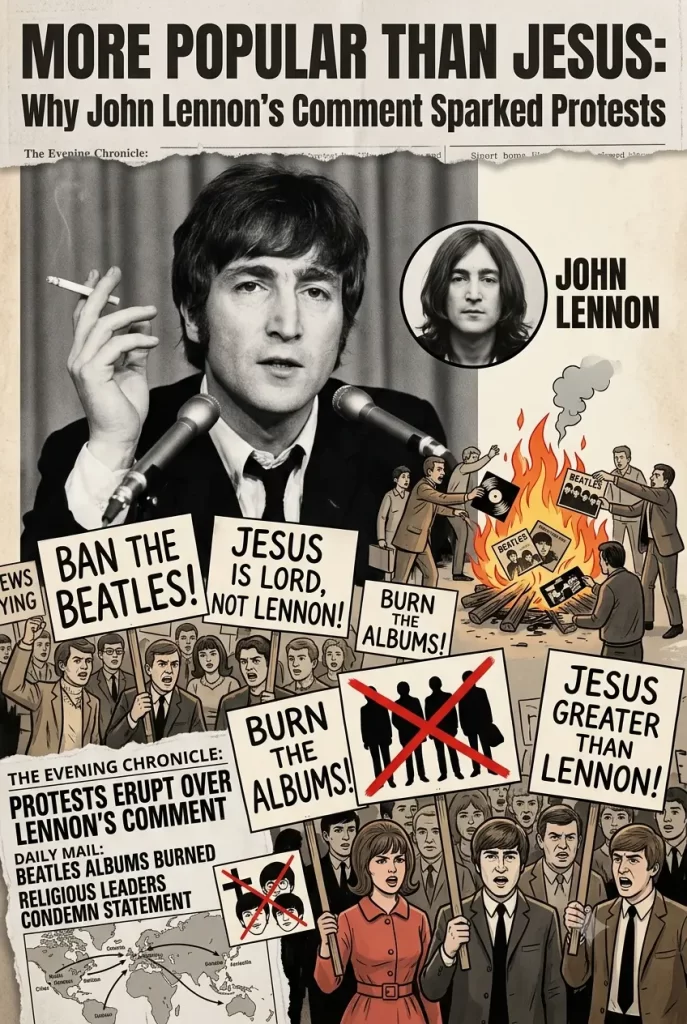
Within days, radio stations across the Bible Belt began reacting strongly. A pair of disc jockeys in Birmingham, Alabama, launched what they called a Beatles boycott, urging listeners to bring in Beatles records and merchandise to be destroyed.
The reaction spread quickly through other Southern cities. Here’s how the protest movement escalated:
- Radio stations pulled Beatles songs from rotation entirely
- Organized bonfires were held where fans burned records and posters
- Roadside signs appeared with slogans rejecting the band in favor of religion
- The Ku Klux Klan joined in, picketing outside Beatles concert venues
- Some venues received bomb threats tied directly to the controversy
This wasn’t a small, isolated reaction. It became a genuine safety concern for the band’s upcoming US tour.
Why the Timing Made It Worse
The controversy hit just as the Beatles were preparing to tour America again in August 1966. Manager Brian Epstein was worried enough about the danger that he considered canceling the entire tour, even offering to personally cover the financial loss.
No venues actually canceled their shows, but the tension around each stop was real. Security had to be tightened, and the band traveled under a level of pressure they hadn’t experienced before.
The Beatles’ Response
Lennon initially avoided commenting directly, letting Cleave and Epstein try to explain the context to the press. That didn’t fully calm things down.
By early August 1966, as the tour approached, Lennon agreed to hold a press conference in Chicago to address it directly. In front of American television cameras, he clarified that he never meant it as an attack on religion and expressed regret for how it had been taken.
It wasn’t a dramatic, tearful apology. It was more of a tired, slightly sarcastic explanation from someone surprised by how far a casual comment had traveled.
Why the Backlash Feels So Extreme Looking Back
Reading about it now, the gap between the original comment and the reaction is almost jarring. Lennon wasn’t setting out to provoke American religious communities at all. He was talking about British teenagers in a British newspaper.
A few factors combined to turn a mild observation into a full-blown scandal:
- Loss of context. Removing the quote from the full interview made it sound like a direct insult rather than a passing observation.
- Regional sensitivity. The Bible Belt in 1966 was especially protective of religious identity, making the comment land far harder there than anywhere else.
- Media amplification. Once a few radio stations pushed the story, others jumped on for attention, spreading it faster than any single outlet could have alone.
- Existing tension around the Beatles. The band was already seen by some conservative groups as a symbol of changing youth culture, so this gave critics an easy target.
What Actually Happened During the 1966 Tour
Despite the fear going into it, the tour went ahead as scheduled. Shows still sold well in most cities, and the protests, while loud, were often smaller in person than they appeared in news coverage.
Still, the pressure took a toll. Many historians point to this tour, and the stress surrounding it, as one of the reasons the Beatles decided to stop touring altogether after 1966. Between this controversy and other pressures of live performance at the time, the band was ready to focus purely on studio work going forward.
Long-Term Impact on the Beatles
The More Popular Than Jesus controversy didn’t end the band’s career, obviously, but it did mark a shift. It was one of the first moments where the public saw the Beatles as something more complicated than harmless pop stars.
Paired with other events from that same year, like the Beatles Butcher Cover controversy over their “Yesterday and Today” album, 1966 became a turning point. The band moved from safe, easily marketable figures into something more unpredictable and, in some ways, more interesting.
What Surprised Me Most Researching This
Going in, I expected Lennon’s comment to sound more arrogant or provocative in its original form. It really doesn’t. Read in full, it comes across as a fairly ordinary, slightly gloomy observation about religion losing ground to pop culture among young people.
The scandal really came down to editing choices at a magazine thousands of miles away, not anything especially shocking in what Lennon actually said. That gap between intention and outcome is honestly the most interesting part of the whole story.
Frequently Asked Questions
What did John Lennon actually say about Jesus?
He said Christianity was declining and suggested the Beatles had, culturally, become more relevant to many young fans than Jesus, based on how British teenagers were shifting their interest toward music over religion.
Why did the comment cause no reaction in the UK?
British readers saw the full context of the interview, and church attendance decline was already a known topic at the time, so the comment didn’t stand out as shocking.
Why did it become such a big deal in the US?
An American teen magazine reprinted the quote out of context on its cover months later, stripping away the nuance and making it sound like a direct religious insult.
Did the Beatles cancel their 1966 tour because of it?
No shows were officially canceled, though manager Brian Epstein considered it due to safety concerns. The tour went ahead despite ongoing protests in several cities.
Did John Lennon apologize for the comment?
Yes, at a press conference in Chicago in August 1966, Lennon explained he never meant it as an attack on religion and expressed regret over how it had been interpreted.
Editor’s Opinion
i think this whole thing shows how easy it is to take somebody’s words out of contex and blow it up into something totaly different. lennon wasnt even trying to start drama, he was just answering a question honestly. its kinda crazy that a magazine cover caused actual record burnings and death threats over one sentance. makes you think about how the same thing happens today with social media, just faster. people get mad first and read the full quote later, if ever.