The Beatles Butcher Cover: What Really Happened in 1966
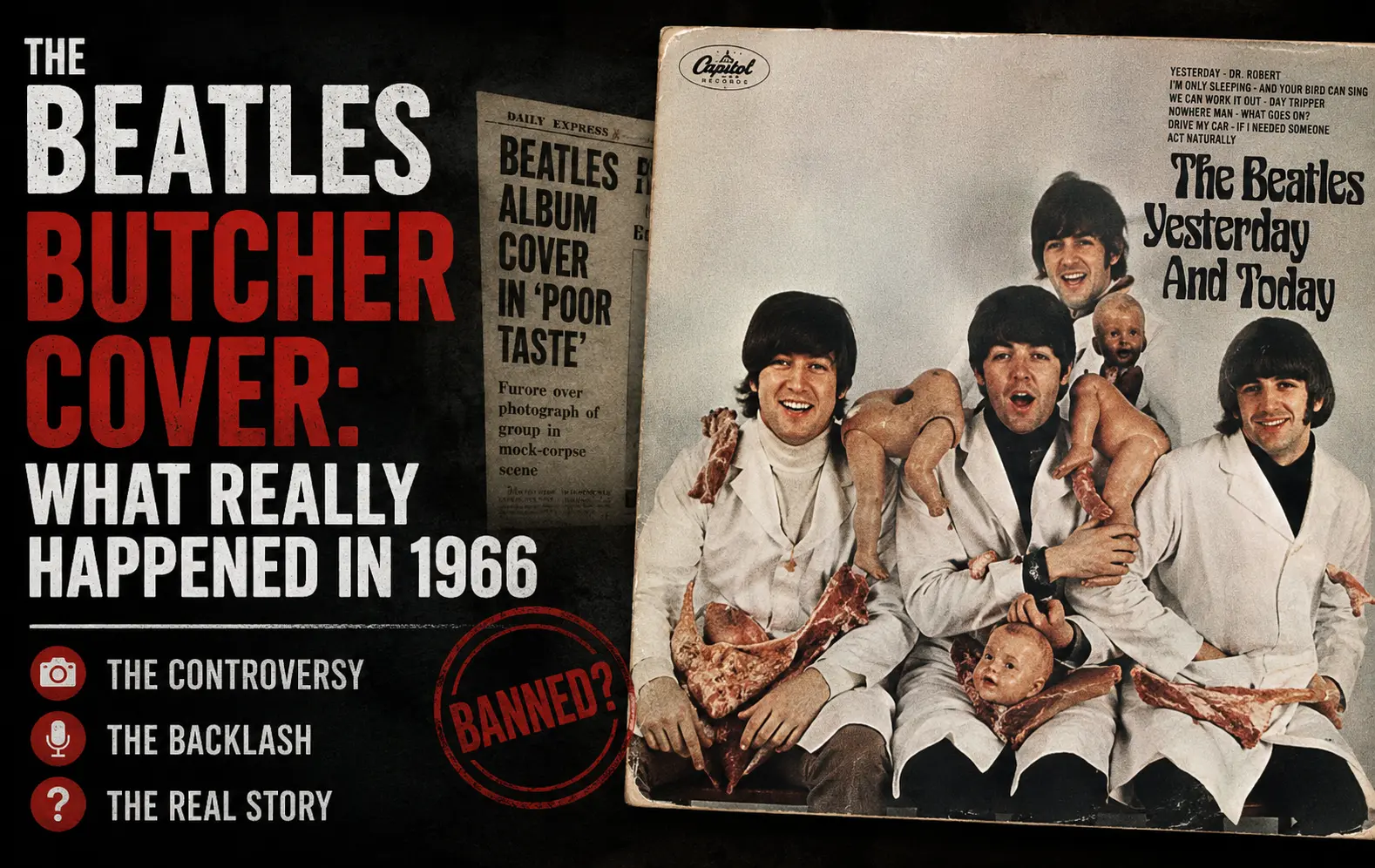
I still remember the first time I saw the Beatles Butcher Cover. A friend of mine, a serious record collector, pulled out an old vinyl sleeve and just said, “Look at this.” Four smiling faces, butcher smocks, raw meat, and dismembered dolls. It didn’t look like anything else the Beatles ever put out, and honestly, it still feels shocking almost sixty years later.
That reaction is exactly why this cover has stayed famous for so long. It wasn’t a random mistake or a bad photo choice. It came from real frustration, real artistic ambition, and a record label that badly misjudged how people would react.
Quick Answer
The Beatles Butcher Cover was the original artwork for the 1966 US album “Yesterday and Today.” It showed John, Paul, George, and Ringo in butcher coats, covered with raw meat and doll parts. Photographer Robert Whitaker created the image as part of an art concept, and John Lennon reportedly pushed for it to be used as the album cover. Capitol Records pulled it within days after stores and reviewers reacted with outrage, and it was replaced with a tamer photo of the band sitting around a steamer trunk.
Why the Cover Caused Such a Big Reaction
By early 1966, the Beatles were the biggest band on the planet. They had passed the point of simple pop stardom and were starting to push back against the machine that made them famous.
Capitol Records, their American label, had a habit of rearranging Beatles albums for the US market. Songs were cut, added, or moved around from what the band originally released in the UK. This annoyed the group, especially Lennon, who felt their work was being chopped up for profit.
So when photographer Robert Whitaker set up a shoot in London in March 1966 for an art project called “A Somnambulant Adventure,” the timing lined up perfectly with that frustration. The Beatles, tired of the usual “four guys smiling in a row” photos, went along with something darker and stranger.
The Photo Shoot Itself
Whitaker had the band put on white butcher smocks. Then he added:
- Slabs of raw meat draped across their laps and shoulders
- Decapitated heads from plastic baby dolls
- False teeth and other odd props scattered through the set
The band actually seemed to enjoy it. Reports from the session describe a playful, almost joking mood, not a serious protest photo shoot. It matched their sense of dark humor at the time.
The Theories Behind the Meaning
There isn’t one single confirmed explanation, and that’s part of why the story still gets discussed today. A few main theories keep coming up.
- A protest against Capitol Records. The most repeated theory says the image was a symbolic jab at the label for “butchering” their albums in America.
- Simple avant-garde art. Whitaker himself described the shoot as a way of linking real people to something raw and real, not meant as shock for shock’s sake.
- Dark humor, nothing deeper. Some Beatles historians argue the band just found it funny and strange, without any grand statement behind it.
Whichever version is true, one thing is clear. Lennon was the one who pushed hardest to actually use it as the Beatles Butcher Cover for the finished album, not just as a promo shot.
How Capitol Records Reacted
The album, “Yesterday and Today,” combined tracks from “Help!,” “Rubber Soul,” a few singles, and songs that would later appear on “Revolver.” It was a US-only release built to fill gaps in the American catalog.
Capitol printed the album with the butcher photo and started shipping copies and promo materials to stores and radio stations in June 1966. The backlash was almost immediate.
Retailers refused to stock it. Reviewers called it tasteless. Some radio stations wouldn’t even show the cover on air. Capitol panicked and pulled the album from shelves within days of release, a huge and expensive move for a major label.
The Fix: The Trunk Cover
Rather than scrap the artwork completely, Capitol took a cheaper route. They photographed the band sitting around an open steamer trunk and pasted this new image directly over the existing butcher covers already printed.
This created what collectors now call “second state” covers, sleeves with the trunk photo glued over the original butcher image underneath. Some fans later peeled off the top layer at home, which created a third version entirely.
Why the Album Still Sold Well
Despite the chaos, the record itself did fine. Once the calmer trunk cover was in stores, “Yesterday and Today” climbed to number one on the Billboard chart and stayed there for weeks. It was later certified as a million-seller and eventually reached double-platinum status in the US.
So the controversy hurt Capitol’s nerves more than it hurt actual sales. People still wanted the music, even if the packaging had been swapped out overnight.
What the Beatles Said Later
At the time, Lennon defended the image, arguing that people who could accept real war images shouldn’t be so bothered by a staged photo. That’s a pretty bold comparison, and it shows how strongly he felt about the artistic point.
Years later, though, both Lennon and George Harrison admitted they had some regrets about it. Producer George Martin was more blunt, calling the whole thing simply in poor taste.
That mix of pride and regret is common in Beatles history. A lot of their boldest moves in 1966, including Lennon’s comments about religion later that same year, caused headaches at the time but became famous footnotes later on.
Why Collectors Still Chase This Cover Today
The Beatles Butcher Cover is now one of the most valuable pieces of Beatles memorabilia in existence. Here’s a simple breakdown of what collectors look for:
- First state covers – original butcher photo, no trunk image pasted over it. These are the rarest and most expensive.
- Second state covers – butcher photo underneath, trunk photo pasted on top. Still highly valuable, especially in good condition.
- Third state (peeled) covers – fans removed the pasted trunk photo themselves, exposing the butcher image again, often with some damage.
- Fourth state covers – printed later with only the trunk photo, no butcher image at all underneath.
Prices vary wildly depending on condition and state. Standard first state copies can sell for several hundred dollars, while sealed, mint condition originals have sold for tens of thousands. In one particularly famous sale, a copy signed by Lennon, McCartney, and Starr sold at auction for well over a hundred thousand pounds.
What Actually Surprised Me Researching This
Going into this, I assumed the Beatles Butcher Cover was purely a protest statement, something planned out carefully as a message to Capitol. That’s the version that gets repeated most often online.
But looking closer, it seems more like a mix of things happening at once. Whitaker had his own art concept unrelated to any protest. The band was just bored with typical photo shoots and enjoyed the weirdness of it. Lennon then saw an opportunity to make a statement and pushed to use it as the actual cover.
So it wasn’t one clean motive. It was art, boredom, and frustration with Capitol all colliding at the same time, which honestly makes the story more interesting, not less.
Lasting Impact on the Beatles’ Image
This wasn’t just a one-off scandal that faded away. It marked a turning point in how the public saw the band.
Before 1966, the Beatles were mostly seen as cheerful, clean-cut entertainers. After the butcher cover and Lennon’s later religious comments that same year, the public image shifted toward a band willing to provoke, question, and push boundaries.
That shift lined up with their music too. Albums like “Revolver” and later “Sgt. Pepper’s Lonely Hearts Club Band” moved far away from simple pop songs into more experimental territory. The Beatles Butcher Cover, in a strange way, was an early visual signal of that change.
Advanced Note for Serious Collectors
If you’re trying to identify a genuine first state copy, a few details matter beyond just the cover image itself:
- Check for any visible edges or bubbling from a pasted-over photo, which would indicate a second state instead
- Look at matrix numbers on the vinyl itself, since these can help confirm pressing details
- Be cautious of counterfeit reproductions, which have circulated for decades given how valuable original copies are
Getting a professional appraisal is worth it before spending serious money on any copy claiming to be a first state Beatles Butcher Cover.
Frequently Asked Questions
What is the Beatles Butcher Cover?
It’s the original 1966 album artwork for “Yesterday and Today,” showing the Beatles dressed as butchers, covered in raw meat and doll parts, before Capitol Records replaced it with a tamer photo.
Why did Capitol Records pull the cover?
Stores, reviewers, and radio stations reacted with outrage almost immediately after release. Capitol pulled the album within days to avoid further backlash and financial loss.
Who came up with the idea for the cover?
Photographer Robert Whitaker created the concept as part of a broader art project. John Lennon is generally credited with pushing to actually use the image as the album cover.
Is the Beatles Butcher Cover valuable today?
Yes, original first state copies are among the most valuable pieces of Beatles memorabilia, with mint condition copies selling for tens of thousands of dollars at auction.
Did the Beatles regret the cover?
Lennon initially defended it strongly, but he and George Harrison later expressed some regret about how it was received. George Martin called it simply in poor taste.
Editor’s Opinion
honestly i think the butcher cover is one of the coolest things the beatles ever did, even tho it freaked ppl out back then. it wasnt trying to be nice or safe, it was just weird and real, kinda like real art should be sometimes. capitol totaly overreacted if you ask me lol. still crazy that peple pay so much money for an old record sleeve today, but i get why, its a piece of history that actualy meant something.