Beatles Rooftop Concert: The Untold Story of Their Final Show
I remember watching grainy footage of this for the first time and thinking it looked more like a workplace disruption than a legendary concert. Four guys in coats, a rooftop, some confused office workers below, and a police officer eventually climbing the stairs to shut it down. That’s genuinely how the Beatles played their last show together.
The Beatles rooftop concert has become one of the most replayed moments in music history, yet the story behind how it almost didn’t happen is just as interesting as the performance itself. It was messy, reluctant, freezing cold, and completely unplanned until about twenty minutes before it started.
Quick Answer
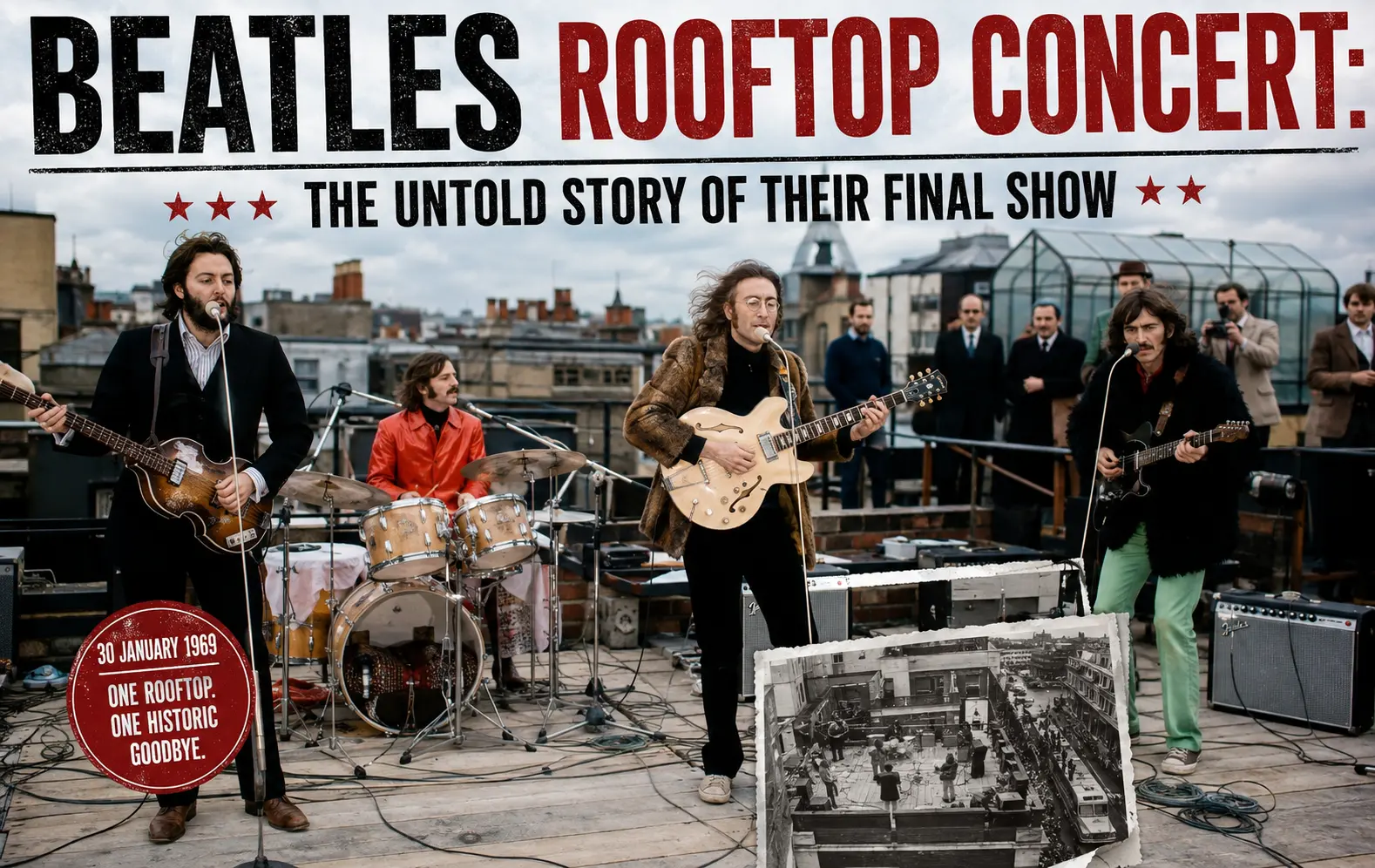
On January 30, 1969, the Beatles performed an unannounced 42-minute concert on the rooftop of their Apple Corps headquarters at 3 Savile Row in London. Joined by keyboardist Billy Preston, they played nine takes of five new songs, including “Get Back,” “Don’t Let Me Down,” “I’ve Got a Feeling,” “One After 909,” and “Dig a Pony.” The performance ended when police arrived after noise complaints from nearby businesses, and it remains the band’s last live public performance. Footage from the show became the climax of the 1970 documentary “Let It Be.”
Why the Concert Happened at All
By late 1968, the Beatles hadn’t performed live since their 1966 US tour. Director Michael Lindsay-Hogg was filming what would become “Let It Be,” a documentary following the band as they wrote and rehearsed new material.
The original plan involved building toward some kind of live concert as a dramatic ending for the film. The problem was nobody could agree on where, or even if, that concert should happen.
The Wild Location Ideas That Never Happened
Before settling on their own rooftop, the band and crew floated several elaborate concert locations. Some of the ideas discussed included:
- An ancient outdoor amphitheater overseas
- A cruise ship sailing somewhere exotic
- A concert staged in the middle of a desert
- More practical London venues like the Roundhouse or the Palladium
None of these plans stuck. Eventually, the idea of simply climbing onto the roof of their own Apple Corps building gained traction, partly credited to Ringo Starr during a lunchtime conversation about how much simpler it would be than traveling anywhere.
The Hours Right Before the Show
Even after all the equipment had been carried up and set up on the roof, the Beatles almost called the whole thing off. Paul McCartney wanted to go through with it. George Harrison reportedly didn’t. Ringo Starr said he’d go either way, leaving the decision hanging.
According to director Michael Lindsay-Hogg, the band hadn’t agreed to perform as a group until roughly twenty minutes before they actually went up. It was John Lennon who broke the tension, deciding they should simply do it.
That kind of last-minute hesitation seems strange for what became such an iconic moment, but it captures how unsettled the band was during this period of their career.
Setting the Scene on the Roof
It was a bitterly cold London winter day, with strong wind but no rain. The band dressed for the weather rather than for the cameras.
A few small details stand out from that morning:
- John Lennon wore a fur coat that belonged to Yoko Ono
- Ringo Starr wore his wife Maureen’s red raincoat
- Paul McCartney and Ringo were the first to reach the rooftop, along with Maureen and Billy Preston
- The band gathered downstairs beforehand, still uncertain about going through with the performance
Producer George Martin and engineer Glyn Johns monitored the whole thing from a basement studio using a closed-circuit television feed, since they weren’t physically on the roof themselves.
The Camera Setup Behind the Scenes
To capture both the performance and the public reaction, the production team used a surprisingly elaborate camera arrangement for something this improvised.
Ten cameras were used in total:
- Five cameras positioned directly on the Apple rooftop
- One camera placed on a rooftop across the street
- Three cameras stationed at street level to film onlookers
- One hidden camera tucked inside the building’s reception area
That hidden lobby camera turned out to be especially useful, capturing genuine, unscripted reactions from people arriving at the building, including early conversations with police officers before they even reached the roof.
What the Beatles Actually Played
The band ran through nine takes covering five songs during the 42-minute set. The material was brand new, written and rehearsed only in the weeks leading up to the performance.
The songs performed were:
- “Get Back”
- “Don’t Let Me Down”
- “I’ve Got a Feeling”
- “One After 909”
- “Dig a Pony”
Several of these takes later made their way onto the “Let It Be” album, giving fans a rare direct link between this rooftop moment and the band’s officially released material.
How the Public Reacted Below
As the music drifted down into the streets of London’s fashion and office district, confusion spread quickly among pedestrians. Many people were simply on their lunch break, unaware anything unusual was happening.
Word spread fast. Crowds gathered on the street and climbed onto nearby flat rooftops to get a better view, effectively creating an audience despite the concert never being announced publicly beforehand.
Reactions were mixed. Plenty of onlookers seemed delighted by the unexpected free show. Others, particularly nearby business owners, were far less thrilled about the disruption to their working day.
The Neighbors Were Not Amused
One nearby company director was recorded complaining loudly about the noise, demanding it be stopped immediately. According to contemporary newspaper coverage, Paul McCartney essentially answered him mid-performance by launching straight into “Don’t Let Me Down.”
That kind of tension, mixing genuine artistic history with an actual noise complaint, is part of what makes this story so memorable. It wasn’t a polished, sanctioned event. It was four musicians and a keyboardist causing a legitimate disturbance in the middle of a business district.
Why the Police Got Involved
Eventually, enough complaints reached the Metropolitan Police that officers were dispatched to the scene. Their goal wasn’t to arrest anyone or forcibly stop the music entirely, just to bring the volume down given the growing crowd and traffic disruption.
Years later, one of the officers involved reflected on the event, noting there was actually no legal power of arrest since the performance was happening on private property. He also expressed surprise at how much attention the incident received decades afterward, given how routine it felt to him at the time as simply managing a noise complaint.
How the Concert Ended
The set closed with “Get Back,” and immediately afterward, John Lennon delivered one of the most quoted lines in Beatles history, joking that he hoped the group had passed the audition.
It was a fitting, slightly sarcastic way to close out what would turn out to be the band’s final live performance together as a group, ever.
Why This Moment Still Matters Today
Beyond the music itself, the Beatles rooftop concert captured something rare: an unplanned, unpolished, and completely human moment from a band that had spent years being carefully managed and marketed.
There was no ticketed audience, no rehearsed crowd interaction, and no guarantee it would even happen until minutes before it started. That rawness is part of why footage from this performance has remained so widely watched and discussed for decades.
In 2021 and 2022, Peter Jackson’s documentary project “The Beatles: Get Back” brought renewed attention to the full, unedited rooftop performance, and the complete audio was officially released to streaming platforms as well.
What Surprised Me Most Researching This
Going into this, I assumed the rooftop concert was a fully intentional, carefully staged finale for the “Let It Be” film. It really wasn’t.
The band nearly abandoned the whole plan minutes before going up, after weeks of indecision about where or whether to perform live at all. Discovering how close this legendary moment came to simply not happening made the whole story feel far more human, and honestly a lot more interesting than the polished legend most people know.
Frequently Asked Questions
When was the Beatles’ rooftop concert?
It took place on January 30, 1969, on the rooftop of their Apple Corps headquarters at 3 Savile Row in London.
Why did the Beatles perform on a rooftop?
After struggling to agree on a traditional concert location, the band settled on their own building’s rooftop as a simpler alternative that still provided a dramatic ending for their documentary film.
What songs did the Beatles play during the rooftop concert?
They performed nine takes covering five songs: “Get Back,” “Don’t Let Me Down,” “I’ve Got a Feeling,” “One After 909,” and “Dig a Pony.”
Why did the police stop the concert?
Nearby businesses complained about the noise and street disruption, prompting police to ask the band to lower the volume rather than to formally shut the performance down.
Was this really the Beatles’ last live performance?
Yes, this rooftop concert remains the final public performance by all four Beatles together, marking the true end of their live touring career.
Editor’s Opinion
honestly this is my favorite beatles story just becuase of how messy and real it is. no fancy planning, george didnt even wanna do it at first, and they almost didnt go up there at all. then john just says lets do it and boom, music history. i also love that some random office guy just wanted the noise to stop lol, thats such a normal human reaction to have during a legendary moment. feels way more real then most “iconic” music events you hear about.