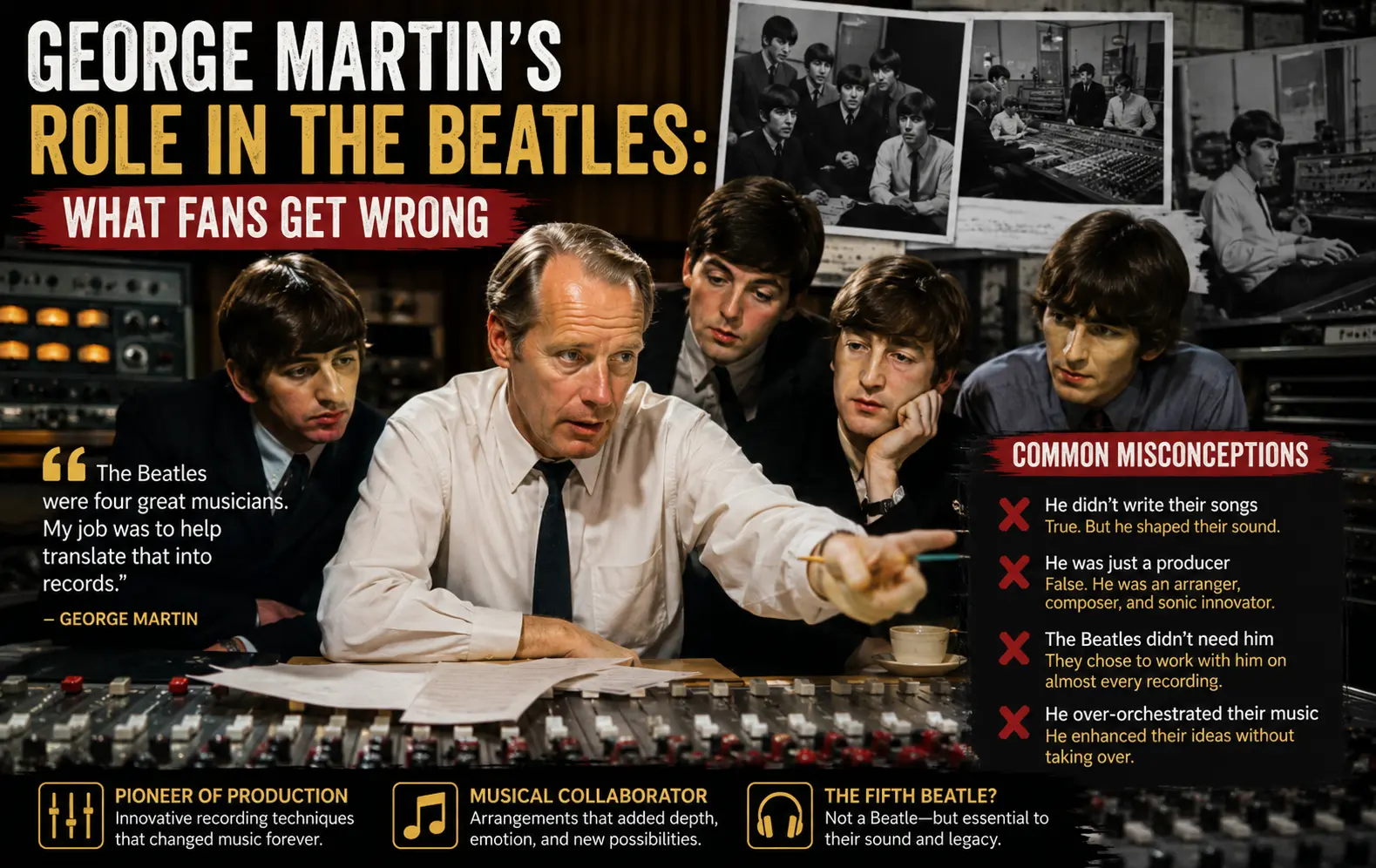
George Martin’s Role in the Beatles: What Fans Get Wrong
I used to think George Martin was basically just the guy who pressed record and kept the Beatles on schedule. That’s the version of the story a lot of casual fans grow up with, a quiet, buttoned-up producer standing off to the side while the real magic happened in front of the microphones.
The actual story is a lot messier and a lot more interesting. George Martin‘s role in shaping the Beatles’ sound involved real musical decisions, real arguments, and real creative risk, not just supervision from a control booth. A surprising number of common beliefs about him don’t hold up once you look closer.
Quick Answer
George Martin was the Beatles’ producer and arranger from 1962 until nearly the end of their career, missing only their final album “Let It Be,” which was produced by Phil Spector. Fans often overstate his control over the songwriting itself and understate his direct musical contributions, like orchestral arrangements, tape manipulation, and persuading the band to try ideas they initially resisted. He wasn’t a strict classical authority imposing rules on the group. He was closer to a musical translator, turning the band’s raw ideas into finished, often groundbreaking recordings.
Myth One: He “Discovered” the Beatles Single-Handedly
A common version of the story credits Martin with spotting the Beatles’ talent when nobody else could see it. That’s not quite accurate.
Several other record labels had already turned the band down before Martin ever heard them. Manager Brian Epstein was the one pushing hard to get any label to take a chance on the group.
When Martin finally listened to their demo, he wasn’t immediately blown away either. He later admitted the recording had an unusual roughness and something he couldn’t fully explain, but it wasn’t a moment of instant, obvious genius on tape. The real spark came after he met the band in person and heard their personalities and humor come through.
Myth Two: He Was a Strict Classical Authority Who Controlled Everything
Fans sometimes imagine Martin as a stiff, formally trained musician who dictated arrangements to four young rock musicians who didn’t know any better.
The relationship worked the opposite way just as often. When Paul McCartney brought in “Yesterday,” Martin suggested adding a string quartet. McCartney initially pushed back hard, insisting the Beatles were a rock and roll band and that strings didn’t belong.
Martin persuaded him to try it anyway. The result became one of the most covered songs in music history, built entirely around an idea the songwriter himself doubted at first.
A Two-Way Creative Relationship
This pattern repeated throughout their career. Sometimes Martin proposed something the band resisted. Other times, the Beatles pushed for sounds Martin had to figure out how to actually create using 1960s studio technology.
For “A Day in the Life,” Paul McCartney wanted an enormous, chaotic orchestral crescendo. Martin took that vague creative request and turned it into a real, scored arrangement, giving the orchestra loose instructions to build from the lowest note to the highest across 24 measures.
That back-and-forth, rather than one-directional control, defined most of their collaboration.
Myth Three: He Wrote the Music Fans Attribute to Lennon and McCartney
Some fans assume Martin quietly co-wrote large portions of the band’s material, given how deeply involved he was in shaping the final sound. Songwriting credit, however, stayed almost entirely with Lennon and McCartney.
What Martin actually contributed was arrangement, orchestration, and studio technique, work that shaped how a song sounded without changing who got credit for writing it. He scored string parts, arranged brass and orchestral sections, and helped translate melodic ideas the band could hum but not necessarily write down on paper, since none of them could read or write sheet music fluently.
This distinction matters a lot. Arranging “Eleanor Rigby” for strings, for example, was entirely Martin’s musical execution, even though the song itself belonged to McCartney.
Myth Four: He Produced Every Beatles Album
It’s widely assumed Martin produced the band’s entire catalog from start to finish. He actually produced every studio album except one.
“Let It Be,” released in 1970, was instead handled by producer Phil Spector, who reworked much of the original session material after the Beatles had already effectively stopped functioning as a working band.
Out of the group’s full run of albums, Martin’s fingerprints are on nearly everything else, including “Sgt. Pepper’s Lonely Hearts Club Band,” “Revolver,” “Rubber Soul,” and “Abbey Road.”
Myth Five: He Received Full Royalties for His Contributions
Given how central Martin was to the band’s sound, many fans assume he was compensated accordingly, receiving ongoing royalties tied to the songs he helped shape.
In reality, his financial arrangement with EMI at the time didn’t reflect his creative contribution nearly as generously as fans might expect. This mismatch between his artistic role and his compensation was part of what eventually pushed him to leave EMI and start his own independent studio, AIR Studios, where he could negotiate more fairly with the artists he worked with going forward.
Myth Six: He Was Only a “Producer” in the Modern Sense
Modern listeners sometimes picture a producer as someone who mainly organizes sessions and manages technical recording equipment. Martin’s actual role blended several different jobs at once.
He was:
- A trained composer and arranger with formal music education
- An A&R figure responsible for signing and developing the band
- The person who scored string and orchestral parts by hand
- A studio innovator experimenting with tape speed, splicing, and unconventional recording techniques
- A calming, experienced presence guiding four young musicians through an increasingly complex creative process
Before working with the Beatles, Martin had produced classical recordings and comedy records for performers like Peter Sellers and Spike Milligan. That unusual background gave him comfort experimenting with odd sounds and studio tricks long before the Beatles started asking for them.
Myth Seven: The “Fifth Beatle” Title Was Official or Uncontested
Fans often repeat the “fifth Beatle” nickname as though it’s a settled fact, but even people close to the band disagreed about who actually deserved it.
Paul McCartney publicly said that if anyone earned that title, it was Martin. George Harrison, on the other hand, pointed to two different people entirely, road manager and Apple executive Neil Aspinall and press officer Derek Taylor, as his own picks for the unofficial title.
Some historians argue the position more accurately belongs to bassist Stu Sutcliffe, an actual early member of the band before Ringo Starr or George Martin were ever involved. The nickname says more about how meaningful Martin’s contribution felt than it does about any official band status.
What Martin’s Musical Instincts Actually Looked Like
A few specific moments show just how hands-on his musical involvement really was, beyond simple supervision:
- “Yesterday” — pushing for a string quartet against McCartney’s initial resistance
- “In My Life” — recording a baroque-style piano solo at a slower speed, then speeding up the tape afterward to create its distinctive tone
- “A Day in the Life” — translating a vague, ambitious creative request into a fully scored orchestral crescendo
- “Eleanor Rigby” — arranging the string octet that became the song’s entire musical backbone, with no guitars or drums at all
None of these were passive production decisions. Each required real compositional skill applied directly to the band’s raw musical ideas.
Why the Misconceptions Persist
Part of why these myths stick around is simple. Producers, even legendary ones, rarely get the same spotlight as the performers themselves. Fans naturally focus on the four members standing at the microphones, not the person guiding decisions from the control room or scoring parts late at night for a session the next morning.
Martin himself seemed to prefer it that way. He often downplayed his own importance publicly, even while colleagues and biographers described him as functioning like a third or fourth creative voice within the band during key periods of their career.
What Surprised Me Most Researching This
Before looking into this properly, I assumed Martin’s biggest contribution was simply keeping four talented but chaotic young musicians organized in the studio. That undersells him significantly.
The actual back-and-forth between Martin and the band, especially moments where he had to convince a skeptical songwriter that his instincts were right, shows a level of creative confidence and risk that goes well beyond traditional producing. He wasn’t managing the Beatles’ sound from a distance. He was actively shaping it from inside the room.
Frequently Asked Questions
Did George Martin write any Beatles songs?
No, songwriting credit stayed with Lennon and McCartney almost entirely. Martin’s contributions came through arranging, orchestration, and studio production rather than songwriting itself.
Which Beatles album did George Martin not produce?
He did not produce “Let It Be,” released in 1970. That album was instead handled by producer Phil Spector.
Why is George Martin called the “fifth Beatle”?
The nickname reflects how deeply involved he was in shaping their musical sound, though the title is unofficial and disputed by several people close to the band.
Did the Beatles resist George Martin’s ideas?
Yes, at times. Paul McCartney initially pushed back against adding strings to “Yesterday” before Martin convinced him to try the arrangement.
Was George Martin properly compensated for his contributions?
Not fully, according to most accounts. His financial arrangement with EMI didn’t reflect his creative importance, which contributed to his decision to eventually leave and start his own independent studio.
Editor’s Opinion
i think people underestimate george martin becuase producers just dont get the spotlight like the actual band members do. dude was classically trained and still willing to fight for weird ideas like slowing down a piano tape, thats not just “supervising” a session thats real musical risk taking. paul callin him the fifth beatle says alot honestly, and it kinda annoys me that he didnt even get paid fairly for all that work at the time.