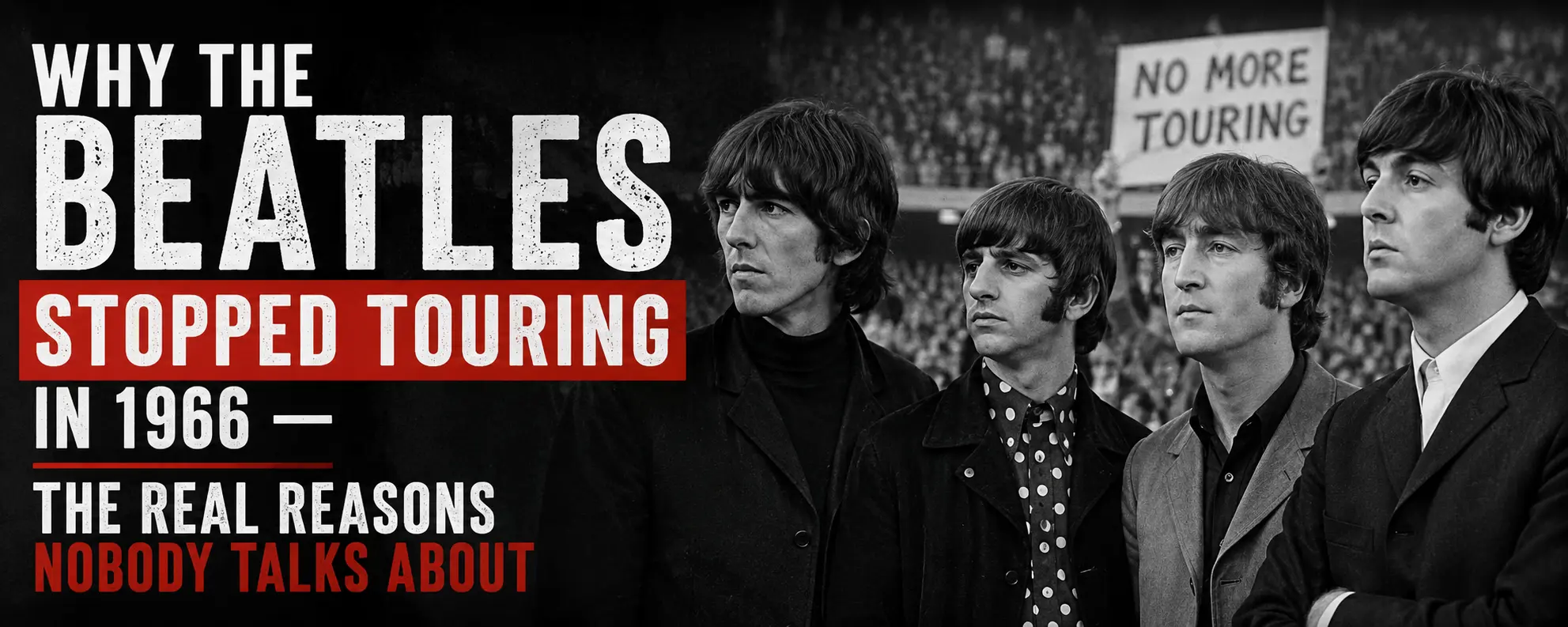
Why The Beatles Stopped Touring in 1966 — The Real Reasons Nobody Talks About
On the evening of August 29, 1966, The Beatles walked off the stage at Candlestick Park in San Francisco and never performed a paid concert again. No farewell tour. No emotional goodbye. No announcement. They simply stepped into an armored vehicle, drove away into the night, and that was it.
The most successful touring act in the history of popular music had played their last show — and most of the 25,000 people in that stadium had absolutely no idea they were witnessing the end of an era.
Most people know the broad outline of why The Beatles stopped touring. They were tired. The crowds were too loud. They couldn’t hear themselves play. But the full story is far more complicated, far darker, and far more fascinating than that simple summary suggests. By the time Candlestick Park came around, The Beatles hadn’t just grown tired of touring. They had been through a series of experiences in 1966 alone that would have broken most people — experiences involving government intimidation, religious fury, death threats, and at least one moment where the entire band genuinely believed someone in the audience was shooting at them.
This is the real story of why The Beatles stopped touring. And it starts not with exhaustion, but with noise.
They Literally Could Not Hear Themselves Play
Before anything else — before the threats, before the controversies, before the physical and psychological toll — there was a fundamental, practical problem that had been building for years.
The Beatles could not hear themselves perform.
By 1965 and 1966, the venues they were playing had grown enormous. Shea Stadium in New York, where they performed in August 1965, held over 55,000 people. The crowds at these shows didn’t just cheer — they screamed, continuously, at a volume that drowned out everything else in the building. The sound technology of the mid-1960s simply had no answer for it. The PA systems that venues used were designed for speaking, not for amplifying a rock band over the sustained roar of tens of thousands of people in a state of collective hysteria.
The result was surreal. The four most famous musicians on the planet were playing their instruments and singing into microphones, and none of them could hear a single note. Not their own playing, not their bandmates, not their vocals. They were essentially miming in front of massive crowds, going through the motions of a performance while the actual music was entirely swallowed by the noise.
Paul McCartney and Ringo Starr had more or less adapted to this bizarre situation. They focused on each other, using visual cues to stay in sync. But John Lennon and George Harrison were increasingly philosophical about what the whole exercise actually meant. If the music couldn’t be heard, what exactly were they doing up there? They weren’t performers at that point — they were attractions, like exhibits in a zoo, objects for the crowd to scream at.
For a band that had grown enormously as musicians and songwriters — a band that was now producing some of the most sophisticated and layered music of its generation — performing these truncated, inaudible sets in football stadiums felt not just unpleasant but genuinely pointless.
Five Years Without a Break
The exhaustion factor is often mentioned but rarely fully appreciated. By 1966, The Beatles had been touring nearly continuously for five years. Not five years with occasional tours — five years in which touring was essentially their permanent state of existence.
It had started in the small clubs and pubs of Liverpool and Hamburg, where they sometimes played eight-hour sets, night after night, developing the extraordinary tightness and musical chemistry that would later astonish the world. Hamburg in particular was brutal — they were playing in rough venues for demanding audiences, sleeping in cramped quarters, sustaining themselves on whatever they could get. Those years built them, but they also ground them down.
When Beatlemania exploded in 1963 and the global touring machine started up in earnest, the pace didn’t slow — it accelerated. Television appearances, press conferences, radio sessions, recording sessions, and hundreds of live performances per year, all while being surrounded by crowds of fans at every hotel, every airport, every restaurant. Their so-called “breaks” were usually recording sessions or film shoots. There was no real off-season, no genuine rest.
By 1966, all four of them were showing the strain. They had relationships and families they rarely saw. They had creative ambitions that couldn’t be pursued on the road. They had interests and inner lives that had essentially been suspended since their early twenties in service of a machine that needed constant feeding. The question was no longer whether they wanted to keep touring — at least two of them clearly didn’t — but when and how the whole thing would finally come to a stop.
The events of 1966 answered that question rather decisively.
Japan: Death Threats at the Budokan
The final world tour began in Germany in June 1966, then moved to Asia. Japan should have been a triumphant stop — the country had developed a passionate Beatles fanbase, and the shows at the Nippon Budokan arena in Tokyo were sold out.
But the Budokan was a venue traditionally reserved for martial arts competitions, and a significant portion of conservative Japanese society viewed The Beatles’ performances there as a desecration of a sacred cultural institution. Protests erupted. Nationalist groups were furious. And before the band had even landed in Japan, death threats began arriving.
The Japanese government responded by deploying approximately 35,000 police officers during the Beatles’ stay in the country — an extraordinary security operation for a rock band. The four of them were essentially imprisoned in their hotel rooms between shows, unable to leave, surrounded by guards. It was a gilded cage, but a cage nonetheless.
The shows themselves went fine. But the atmosphere of the Japan visit — the threats, the protests, the sense of being prisoners of their own fame — set a tone for what was about to follow in the Philippines.
The Philippines: The Night It All Started to Fall Apart
If Japan was unsettling, the Philippines was genuinely dangerous. What happened in Manila in July 1966 remains one of the most dramatic and disturbing episodes in Beatles history — and it pushed George Harrison, in particular, to the conclusion that the whole touring enterprise needed to end.
The band arrived in Manila on July 3rd for two concerts at the Rizal Memorial Stadium the following day. The shows themselves were extraordinary — over 80,000 fans attended across the two performances, the largest single-day audience The Beatles had ever played for.
But the real story wasn’t the concerts. It was the breakfast they didn’t attend.
The local concert promoter, without informing Brian Epstein or the band, had promised the Marcos family — Ferdinand Marcos was the recently elected President, and his wife Imelda was one of the most powerful figures in the country — that The Beatles would appear at a morning reception at the Presidential Palace. The event had been planned for months. Hundreds of children of high-ranking military and government officials were expected. Imelda Marcos herself was hosting.
Nobody told The Beatles. Brian Epstein, who had a strict policy of keeping the band away from political engagements, had already declined on their behalf. But the promoter’s promise had created an expectation that nobody had thought to cancel through the right channels.
The morning after their concerts, The Beatles woke up to their phone lines dead, room service refusing to answer, and a television showing footage of a visibly furious Imelda Marcos, with cameras panning dramatically across empty chairs at a table laid for guests who never arrived. Children crying. Officials looking outraged. The message from the state-controlled media was clear: The Beatles had deliberately snubbed the First Lady of the Philippines, humiliated the Marcos family, and insulted the entire nation.
Brian Epstein attempted to make a televised statement clarifying what had happened. The broadcast was mysteriously disrupted by static at the most important moments. His explanation never reached the public.
The consequences arrived immediately. Hotel staff stopped answering calls. Their police escort — the protection that had been standard at every stop on the tour — vanished entirely. The Marcos government had quietly withdrawn all official support, leaving four of the most famous people in the world and their small entourage completely unprotected in a country that now regarded them as enemies.
Getting to the airport the next morning was a nightmare. The band and their team were jostled, kicked, and shoved by angry crowds. Road manager Mal Evans was beaten. Officials at the airport detained them, demanding they pay taxes on concert earnings before being allowed to leave. Their belongings were searched and delayed. One by one, members of their entourage were pulled aside and harassed.
When they finally boarded the plane, Paul McCartney later recalled that the entire band was kissing the seats in relief. George Harrison was more direct. “After the Philippines,” he said, “we thought — we’ve got to pack this in.”
“More Popular Than Jesus” — The Controversy That Brought the KKK to Their Concerts
The band flew home to England, took a brief break, and then prepared for their final North American tour. What was waiting for them was a firestorm that had been building since March.
In a lengthy interview with the London Evening Standard earlier that year, John Lennon had made an observation about religion and popular culture that was, in context, fairly nuanced. He noted that Christianity seemed to be shrinking as a cultural force, that young people were drifting away from the church, and that by some measures The Beatles had become more central to the lives of teenagers than organized religion.
“We’re more popular than Jesus now,” he said. It wasn’t a boast. It was, in his characteristically blunt way, a cultural observation.
In Britain, the interview was published, noted, and largely moved on from. But when an American teen magazine republished the comments months later, the reaction in the United States — particularly in the Bible Belt — was volcanic.
Radio stations across the South banned Beatles records. Bonfires were organized where fans brought their Beatles albums and memorabilia to be publicly burned. Religious groups held protests outside venues on the upcoming tour dates. And the Ku Klux Klan — the KKK — announced that they would be picketing Beatles concerts across the American South. In some cities, KKK members in full regalia stood outside the venues where The Beatles were performing, holding signs and intimidating fans.
John Lennon apologized — carefully, and somewhat reluctantly — at a press conference in Chicago before the tour began. It helped defuse some of the public anger. But it did nothing to address the death threats, which kept arriving throughout the tour. The band and their security team received warnings before multiple shows that someone in the audience intended to harm them.
This was not abstract paranoia. This was specific, credible intelligence, delivered by people who were supposed to know. And The Beatles had to walk out onto those stages anyway, night after night, and perform in front of crowds where, somewhere out there, someone might be planning to hurt them.
Memphis: The Firecracker That Sounded Like a Gunshot
The psychological toll of performing under those conditions is almost impossible to overstate, and it crystallized into a single terrifying moment during a show in Memphis, Tennessee.
Mid-concert, a firecracker went off somewhere in the audience. The sound cut through the noise of the crowd — sharp, sudden, unmistakable.
All four Beatles looked at each other in the same instant. The same thought crossed every face. The same fear. For a fraction of a second, each of them genuinely believed that someone in the crowd had fired a gun at them.
Nobody said anything. They kept playing. When they came offstage, they discovered what had actually made the noise. But the moment itself — the fear, the vulnerability, the sudden vivid awareness that they were standing in front of tens of thousands of people with absolutely no way to protect themselves — never really left.
The Last Night: An Armored Van at Candlestick Park
The final concert of the tour — and, as it turned out, the final concert of their career — was at Candlestick Park in San Francisco on August 29, 1966.
There was no special ceremony. No speech. No acknowledgment that this might be the last time. The set lasted roughly 35 minutes, as their sets typically did, and covered eleven songs. They played, they finished, and they were escorted out.
The detail that Paul McCartney has returned to most often when describing that night isn’t the music, or the crowd, or any emotional moment on stage. It’s the armored vehicle.
To get in and out of the venue, the band was transported in an armored van — the kind used to move prisoners or high-value cargo. McCartney described what it felt like to be bounced around in the back of that vehicle, unable to see out, unseated and sliding across the floor, with no idea what was happening outside. It felt, he said, like being arrested. Like being cargo. Like being an object rather than a person.
“And finally,” he recalled, “all of us were like — forget this.”
John and George had been saying it for months. Now Paul and Ringo felt it too. The conversation on the flight home was brief, but clear. They were done.
What Nobody Talks About: The Relief
Here is the part of the story that gets overlooked in most tellings. When The Beatles stopped touring, there was no tragedy in the room. There was relief.
The exhaustion, the fear, the noise, the Philippines, the death threats, the armored vehicles — all of it was over. And in its place was something none of them had experienced in years: freedom.
Freedom to sleep. Freedom to be home. Freedom to write music that couldn’t possibly be performed live. Freedom to experiment in the studio without any consideration for what would work in a football stadium. Freedom to be human beings rather than spectacles.
What followed was arguably the most creatively fertile period in the history of popular music. Within a year of stopping touring, The Beatles had recorded Sgt. Pepper’s Lonely Hearts Club Band — an album so musically ambitious that it couldn’t have been created by a band that was still spending six months a year on tour. The studio became their new stage, and everything they had been holding back — every idea too complex, too weird, too technically demanding to work in a live setting — came pouring out.
The Rooftop: One Last Time
There is, of course, a postscript. On January 30, 1969, The Beatles played together in public one final time — not in a stadium, not for a paying audience, but on the rooftop of their Apple Corps headquarters at 3 Savile Row in London.
No announced show. No security cordon. No armored vehicles. Just four musicians on a rooftop, playing for whoever could hear them, until the police arrived and asked them to stop.
It lasted 42 minutes. It was chaotic, cold, and utterly unplanned. And by many accounts, it was one of the best things they ever did.
A Decision That Changed Music Forever
The Beatles stopped touring for reasons that were entirely understandable — practical, physical, and emotional. They had been driven to the edge of what any human being could sustain, in circumstances that had become genuinely frightening.
But the consequence of that decision was something none of them could have fully predicted. By walking away from the stage, they walked toward the studio. And the music that came out of those studio years — Revolver, Sgt. Pepper, The White Album, Abbey Road — changed what popular music could be and do in ways that are still being felt today.
The armored van at Candlestick Park didn’t just mark the end of Beatles touring. It marked the beginning of something far more lasting.