The Beatles Return to 3 Savile Row: Apple Corps Announces Legendary Rooftop Experience
For music historians and fans of rock and roll, certain addresses hold a sacred status. 20 Forthlin Road in Liverpool, Abbey Road Studios in St. John’s Wood, and, perhaps most famous of all, 3 Savile Row in London’s upscale Mayfair district. It was at this elegant Georgian townhouse that Apple Corps Ltd was headquartered, and it was on its cold, windy roof on January 30, 1969, that The Beatles performed in public for the very last time.
For decades, fans could only view the outside of this legendary building, which has hosted offices and retail stores over the years. But that is about to change.
On May 11, 2026, Apple Corps Ltd officially announced plans to launch “The Beatles at 3 Savile Row,” an immersive, seven-floor visitor attraction scheduled to open in 2027. For the first time in history, the public will be granted access to the building’s interior, including the restored basement studio and the famous rooftop where musical history was made.
Let’s dive into the history of this address, what the new attraction will offer, and why this represents the ultimate pilgrimage site for Beatles fans.
The Historical Significance of 3 Savile Row
Purchased by The Beatles in 1968 for their newly formed business empire, Apple Corps, the building at 3 Savile Row quickly became the center of the band’s creative and business universe. It was far more than just a corporate office. It was a creative playground, a recording studio, and a second home for John Lennon, Paul McCartney, George Harrison, and Ringo Starr.
In late 1968, as the band grew increasingly frustrated with the cold atmosphere of film studios during the Get Back rehearsals, they decided to move production to their own headquarters. They moved their gear into the basement of 3 Savile Row, setting up a makeshift recording studio.
Despite initial technical disasters—including a famously botched soundboard design by the band’s eccentric electronics wizard “Magic Alex”—producer George Martin and engineer Glyn Johns got the studio working. In this basement, the band recorded the majority of the tracks that would eventually form their final released album, Let It Be, including “Get Back,” “Two of Us,” and the title track.
The Legendary 1969 Rooftop Concert
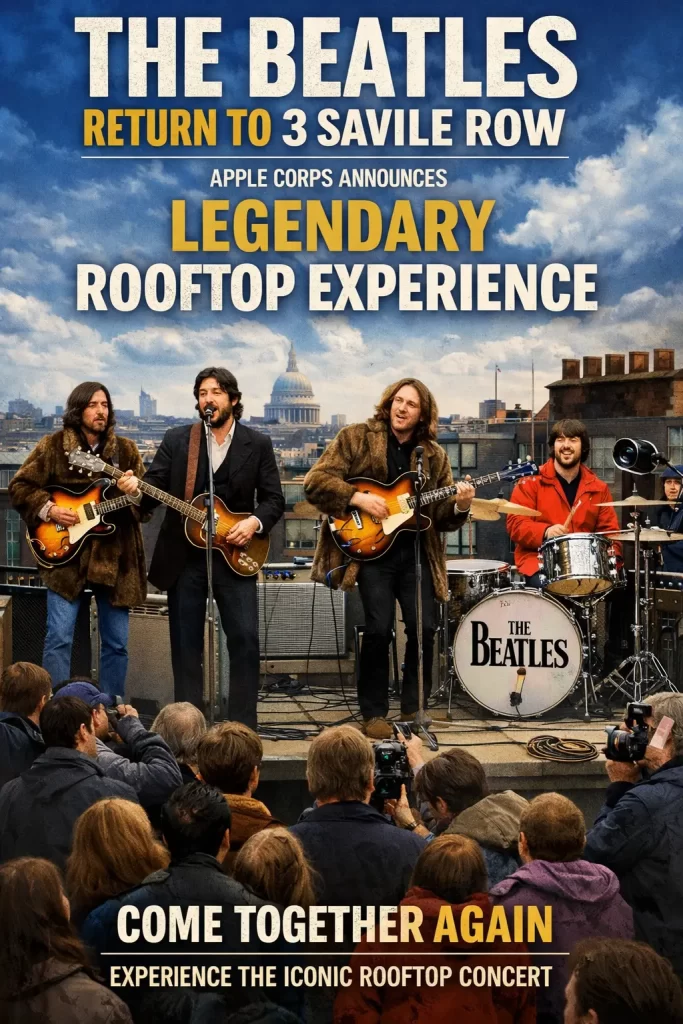
No discussion of 3 Savile Row is complete without mentioning the events of January 30, 1969. Looking for a climax for their documentary film, the band decided, on a whim, to carry their instruments up the stairs and perform an unannounced set on the building’s roof.
Accompanied by keyboardist Billy Preston, The Beatles played a 42-minute set that brought London’s financial district to a virtual standstill. Office workers climbed out of windows, crowds gathered on the streets below, and local businesses complained about the noise. The performance ended when local metropolitan police officers entered the roof and ordered the band to shut down the amplifiers.
As the power was cut, John Lennon famously quipped into his microphone: “I’d like to say thank you on behalf of the group and ourselves, and I hope we passed the audition.”
It was a poignant, spontaneous moment of rock history, representing the final time the four men would play live music together in public.
Inside the Attraction: What Fans Can Expect in 2027
According to the May 11 announcement, the new attraction will occupy all seven floors of the historic townhouse, offering a highly detailed, chronological journey through the band’s time at Apple Corps.
The Basement Studio Reconstruction
Architects and historians are working together to recreate the basement recording studio exactly as it looked in January 1969. Using archival photographs and footage from Peter Jackson’s Get Back documentary, the studio will feature vintage recording consoles, instruments, and microphones. Visitors will be able to stand in the room where the band recorded and hear remastered, raw studio chatter and alternate takes through high-fidelity spatial audio.
The Rooftop Access
The crown jewel of the experience is, without a doubt, the rooftop. For the first time, visitors will be permitted to walk out onto the actual roof where the 1969 concert took place. The space will be preserved to maintain its historic appearance, allowing fans to stand in the exact spots where John, Paul, George, Ringo, and Billy Preston stood during that cold winter afternoon.
The Archive Galleries
The upper floors of the building will house museum galleries featuring never-before-seen materials from the Apple Corps archives. This will include handwritten lyrics written on Apple letterhead, personal correspondence, original contracts, clothing worn by the band members, and instruments used during the Let It Be sessions. The exhibition will also examine the history of Apple Records, the Apple Boutique, and the business chaotic struggles of the late-1960s.
Paul and Ringo Share Their Excitement
Both surviving members of the band have expressed their enthusiastic support for the project. In a statement released alongside the announcement, Ringo Starr reflected on the significance of the building.
“3 Savile Row was a crazy, beautiful place for us,” Starr said. “We did some of our best work in that basement, and playing on the roof is something I will never forget. To open those doors to the fans and let them see where it all happened… it’s like coming home.”
Paul McCartney has also lent his support, working closely with the archive teams to ensure the historical accuracy of the displays.
The announcement comes at a busy time for the two legendary musicians. Both McCartney and Starr are reportedly working on new solo studio albums for 2026, proving that their creative drive remains strong even as they celebrate their historical legacy.
A Holy Grail for Music Tourism
The announcement of “The Beatles at 3 Savile Row” is a massive development for music tourism in the United Kingdom. While Liverpool has long been the primary destination for Beatles tours, London will now boast a site of equal historical gravity.
By restoring the physical spaces where the music was conceived, recorded, and performed, Apple Corps is offering fans something far more valuable than a standard museum exhibition. They are offering a tangible connection to the creative process of the greatest band in music history.
When the doors officially open in 2027, standing on that Mayfair rooftop will undoubtedly become the ultimate bucket-list experience for music fans around the world.
Would you make the trip to London to stand on the famous Savile Row rooftop? Which part of the new attraction are you most excited to see? Let us know in the comments below!