All You Need Is Love: Why It Was Chosen for the Our World Broadcast
I once assumed this song was just a catchy single the Beatles happened to release around the same time as some historic broadcast. It turns out the connection runs much deeper than that. The song was written specifically for the event, built from the ground up to solve a problem almost nobody had ever faced before: how do you write something that hundreds of millions of people, speaking dozens of different languages, can all understand at once.
The All You Need Is Love satellite broadcast wasn’t just a lucky pairing of a great song with a big television event. It was a purpose-built solution to a genuinely strange creative brief, and the story behind it says a lot about how the Beatles approached even the most unusual assignments.
Quick Answer
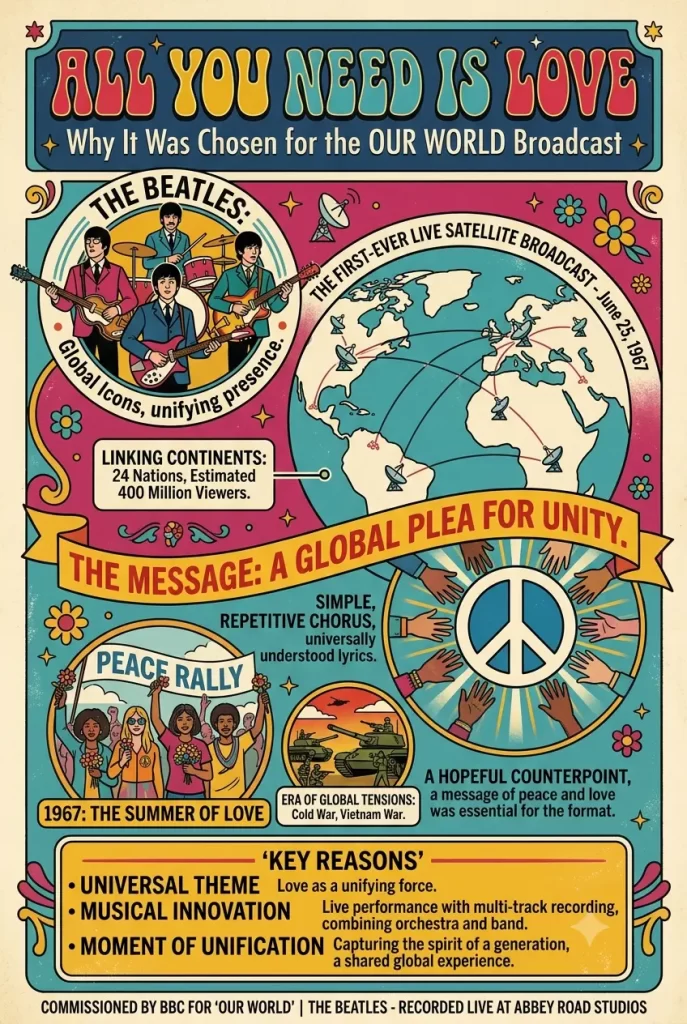
“All You Need Is Love” was chosen for the BBC’s 1967 “Our World” program because the broadcast needed a song simple and universal enough for viewers across dozens of countries to understand without translation. John Lennon wrote it specifically for the occasion, using a repetitive, easy-to-grasp phrase as its emotional core. The Beatles performed it live from Abbey Road Studio One on June 25, 1967, as part of the first satellite broadcast to link countries across the world simultaneously, watched by an estimated 400 million people.
What “Our World” Actually Was
Before understanding why this song mattered, it helps to know just how ambitious the broadcast itself was. “Our World” was developed by the BBC beginning in 1966, with the goal of creating the first live television program ever broadcast simultaneously to countries across multiple continents.
The show connected nations through a combination of early communication satellites, including Intelsat I, known as Early Bird, along with Intelsat II and the ATS-1 satellite. Getting the signal to travel that far, live, in 1967 required enormous coordination between broadcasters and engineers in multiple countries.
Roughly nineteen to twenty-five countries were originally set to participate, depending on the source, though the Soviet Union and Poland withdrew shortly before broadcast day in protest related to the Six Day War. Even with that reduction, the program still reached an estimated audience of around 400 million viewers.
Why the BBC Needed a Universal Song
Each participating country contributed its own short segment. Some featured cultural moments, scientific achievements, or everyday scenes from daily life. Britain’s contribution was music, and the BBC turned to the Beatles to represent the country.
The brief given to the band was unusually specific for a pop song request. Whatever they created needed to be simple enough that someone watching in a completely different language and culture could still feel its meaning without any translation getting in the way.
That’s a difficult creative challenge. Most songs rely heavily on wordplay, cultural references, or complex storytelling that doesn’t always translate cleanly across languages.
How Lennon Solved the Problem
John Lennon took on the challenge personally, writing “All You Need Is Love” specifically to meet that brief. Rather than building the song around a complicated narrative, he centered it entirely on one direct, repeated idea.
The phrase itself needed almost no translation to understand emotionally. Even someone with limited English could follow the general meaning just from tone, melody, and repetition alone.
Two Songs Were Actually Considered
Interestingly, Lennon’s song wasn’t the only option on the table. The band also considered using Paul McCartney’s “Your Mother Should Know” for the same slot.
In the end, Lennon’s composition won out, largely because of how directly its message matched the spirit of global unity the broadcast was trying to promote. Given that 1967 became known culturally as the Summer of Love, the timing genuinely could not have lined up better.
Building a Song With Global Musical References
To reinforce that universal, borderless feeling, Lennon wove in musical quotations from several different traditions rather than sticking purely to a typical rock arrangement.
The finished song opens with a brief quotation from “La Marseillaise,” the French national anthem. Elsewhere in the arrangement, listeners can hear echoes of Bach’s Two-Part Invention in F major, a snippet resembling Glenn Miller’s “In the Mood,” and a passage drawing from the English folk tune “Greensleeves.”
These references weren’t random musical decorations. They deliberately pulled from different eras, countries, and traditions, reinforcing the same universal theme the lyrics were already built around.
Preparing for a Live Global Performance
Performing live for an audience that size came with real technical risk, so the band didn’t leave everything to chance on broadcast day.
They began recording a backing track in the weeks leading up to the event, first at Olympic Sound Studios and later continuing work at EMI’s Abbey Road facility. This allowed them to lock in the instrumental foundation ahead of time, while still performing key vocal and instrumental parts live during the actual broadcast.
Because producer George Martin had other commitments that same day, orchestral arranger Mike Vickers, a member of the band Manfred Mann, was brought in to score and conduct the orchestra for both rehearsals and the live broadcast itself.
A Playful, Star-Studded Atmosphere
Despite the historic weight of the moment, the actual performance stayed lighthearted rather than overly serious. Band members played unusual instrument combinations for the occasion, including John Lennon on banjo, Paul McCartney on double bass, and George Harrison on violin.
The room itself was filled with friends and fellow musicians who joined in on the sing-along ending, including Mick Jagger and Keith Richards from the Rolling Stones, Eric Clapton, Marianne Faithfull, Keith Moon, and Graham Nash. Flowers, balloons, and confetti added to the festive, celebratory feeling surrounding the performance.
Why Abbey Road Studio One Was Chosen
The performance took place in Abbey Road’s Studio One rather than the smaller Studio Two more commonly associated with the band’s recording sessions. Studio One’s larger size made it possible to accommodate the full television crew, cameras, orchestra, and invited guest audience needed for a broadcast of this scale.
Given how many moving pieces needed to fit into one room, that extra space wasn’t a minor detail. It was a practical necessity for pulling off a live international broadcast successfully.
The Broadcast Itself
On June 25, 1967, “Our World” aired as a roughly two-hour program, closing with the Beatles’ live performance as Britain’s featured segment. Earlier portions of the broadcast covered a wide range of global topics, including newborn babies from different countries, contemporary dance performances from France, space technology developments, and artistic segments featuring figures like Pablo Picasso.
The overall tone of the program leaned deliberately away from politics, focusing instead on shared human experiences across cultures. Ending the broadcast with a song built entirely around unity and love fit that overall theme perfectly.
What Happened After the Broadcast
Following its historic live debut, “All You Need Is Love” was released as a single in July 1967 and quickly reached number one in both the UK and the US. It later appeared on the “Magical Mystery Tour” collection as well.
Its connection to “Our World” gave the song a layer of historical significance well beyond a typical chart-topping single. It wasn’t just commercially successful. It became permanently tied to one of television’s earliest demonstrations of truly global, simultaneous communication.
Why the Song Still Resonates Today
Decades later, “All You Need Is Love” remains one of the most recognizable Beatles songs specifically because of how effectively it accomplishes what it was originally built to do. It doesn’t rely on complicated language or cultural specificity to land emotionally.
That simplicity, which could have easily felt like a shortcut in less skilled hands, instead became one of the song’s biggest strengths. It’s hard to think of many songs written for such a specific, narrow purpose that still hold up as genuinely great music on their own, separate from the historical event that inspired them.
What Surprised Me Most Researching This
Going into this, I assumed the Beatles simply picked an existing song that fit the broadcast’s theme reasonably well. Learning that Lennon wrote it entirely from scratch, specifically to meet an unusual creative brief about global translation, changed how I think about the song completely.
It’s easy to forget that even something as seemingly universal and timeless as “All You Need Is Love” started as a practical solution to a very specific, very unusual problem handed down by television broadcasters trying to prove satellite technology could genuinely connect the world.
Frequently Asked Questions
Why was “All You Need Is Love” chosen for the Our World broadcast?
The BBC needed a song simple enough for global audiences to understand without translation, and John Lennon wrote the track specifically to meet that requirement.
When did the Our World broadcast take place?
It aired on June 25, 1967, reaching an estimated audience of around 400 million people across multiple continents.
Was “All You Need Is Love” performed entirely live?
The instrumental backing track was pre-recorded in the weeks before the broadcast, while vocals and select instrumental parts were performed live during the actual event.
Who else appeared during the performance?
Several famous friends joined the sing-along ending, including Mick Jagger, Keith Richards, Eric Clapton, Marianne Faithfull, Keith Moon, and Graham Nash.
Why does the song include quotes from other music?
Lennon included brief musical references from sources like “La Marseillaise,” Bach, and Glenn Miller to reinforce the song’s universal, borderless theme.
Editor’s Opinion
i think its really cool that lennon basically had a homework assignment and turned it into one of the most famous songs ever. writing somthing that HAS to work for millions of ppl in diffrent countries sounds terrifying honestly, but he just kept it dead simple and it worked perfect. also love that mick jagger and keith richards just showed up to sing backup like it was a normal tuesday. this whole event feels like a time capsule of the 60s optimism, in a good way.