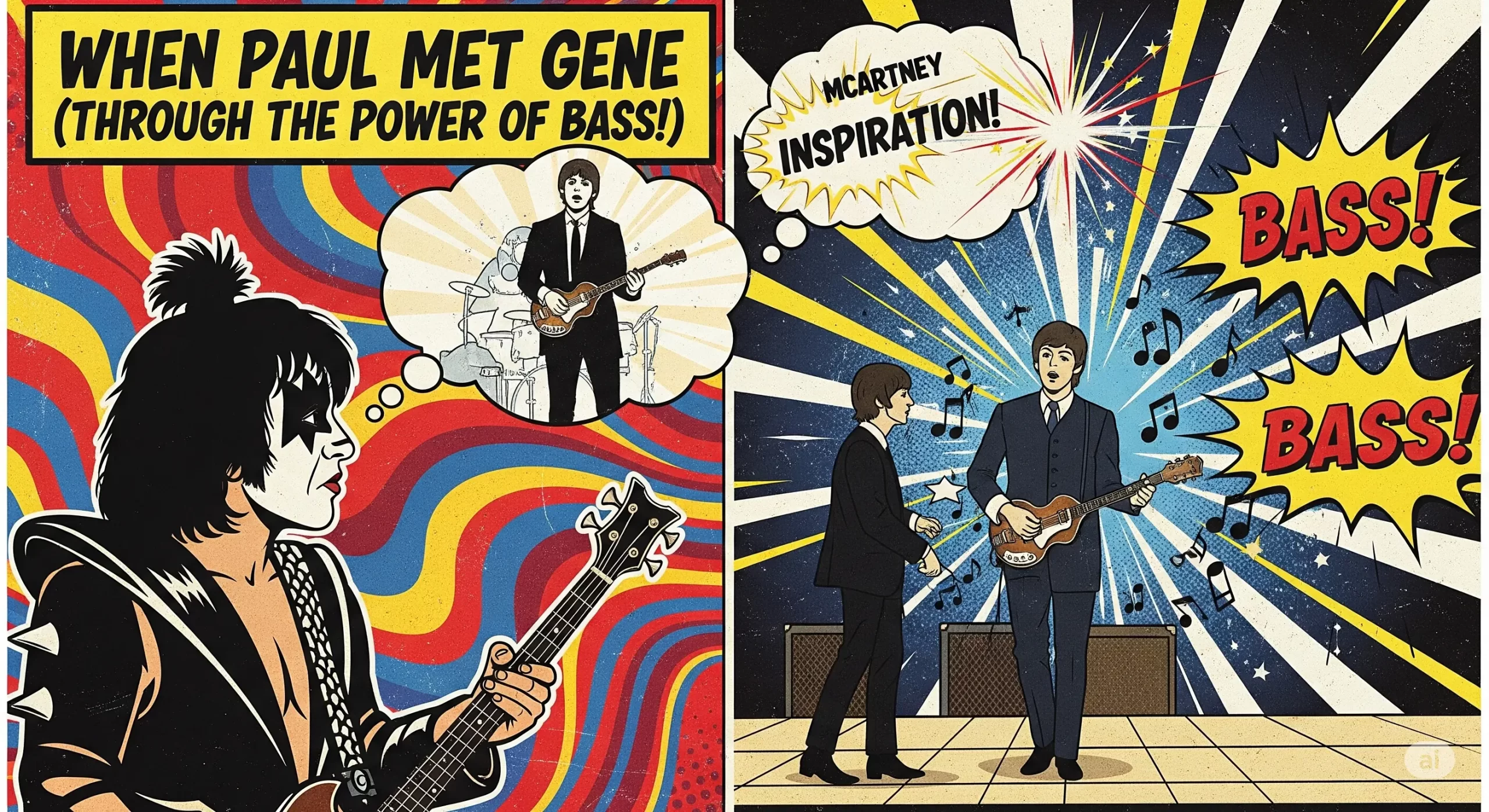
From The Beatles to KISS: How Paul McCartney Inspired Gene Simmons to Play Bass
Any discussion of rock history can almost be divided into two eras: before The Beatles and after The Beatles. While Chuck Berry, Little Richard, and Elvis Presley laid the foundation of rock and roll in the 1950s, it was The Beatles who completely reshaped the genre, combining rock, pop, soul, and even world music into something unprecedented. For a young Chaim Witz—who would later rename himself Gene Simmons—that moment was nothing short of life-changing.
The Beatles’ Impact on a Young Simmons
Like millions of other Americans, Simmons first encountered the Fab Four on The Ed Sullivan Show in February 1964. The performance was an almost spiritual awakening for him.
“When I was a kid, I was affected by The Beatles – like a religious event, like a singularity,” Simmons told SPIN (via MetalCastle). “I wasn’t a musician. I was just a kid. Turn on the TV, and the Beatles came out: ‘She loves you, yeah, yeah, yeah.’ I’m going, ‘What is that? What accent is that?’ And they look like girls, and they’re small human beings with silly haircuts.”
That surreal introduction was enough to push Simmons toward music—and eventually the bass guitar.
Following Paul McCartney’s Lead
Although Simmons began on a second-hand Gibson SG guitar purchased for about $50, his early struggles made him consider switching instruments. The turning point came when he noticed Paul McCartney’s Hofner bass.
“I taught myself how to play,” Simmons recalled. “My 14-year-old fingers bled because I couldn’t make the strings go down. And then I switched to bass because Paul McCartney played a Hofner bass, and my mother bought me a Japanese knockoff.”
That decision would define his career. While McCartney was the charming, melodic bassist of The Beatles, Simmons would later transform the instrument into a weapon of spectacle and power with KISS.
Building KISS on a Beatles Blueprint
After playing in several New York groups, Simmons met Stanley Eisen (later Paul Stanley). Their creative chemistry became the foundation for KISS, especially after recruiting Peter Criss and Ace Frehley.
KISS’s over-the-top theatrics—makeup, pyrotechnics, and bombastic stage shows—might seem galaxies away from The Beatles’ charm. But Simmons himself admits that the Fab Four were always the guiding light.
“Our reference point was The Beatles because we were delusional,” he explained. “We wanted to think of ourselves as The Beatles on steroids.”
Like The Beatles, KISS operated as a democratic band, with each member contributing vocals on early albums. Ace Frehley, often compared to George Harrison, even filled the “quiet one” role.
Admiration for The Beatles’ Work Ethic
Beyond style and sound, Simmons deeply admired The Beatles’ sheer productivity and dedication.
“In the middle of nowhere, you had these four young guys hovering around age 20, 21 years old, who, within seven years, wrote hundreds of classic forever songs,” Simmons said. “‘Michelle,’ ‘Yesterday,’ ‘Eleanor Rigby,’ ‘I Am The Walrus,’ and just hundreds and hundreds of songs.”
To him, KISS was not just a band but a vision of The Beatles reimagined as a rock-and-roll circus from another planet.
The Beatles’ Lasting Legacy in Simmons’ Career
While Simmons’ stage persona, “The Demon,” could hardly be further from the image of McCartney or Lennon, his foundation in music will always trace back to that night in 1964. Seeing The Beatles on television didn’t just inspire him to pick up an instrument; it planted the seeds for one of rock’s most theatrical and enduring bands.
For Gene Simmons, the road to KISS began with four young men from Liverpool—and especially one left-handed bassist with a violin-shaped guitar.
Conclusion
The connection between The Beatles and Gene Simmons highlights how one generation of musicians reshaped the next. Without McCartney’s influence, Simmons might never have chosen the bass, and without The Beatles’ blueprint, KISS might never have become the spectacle it was. Rock history, once again, proves that nearly every path leads back to The Beatles.

One Comment