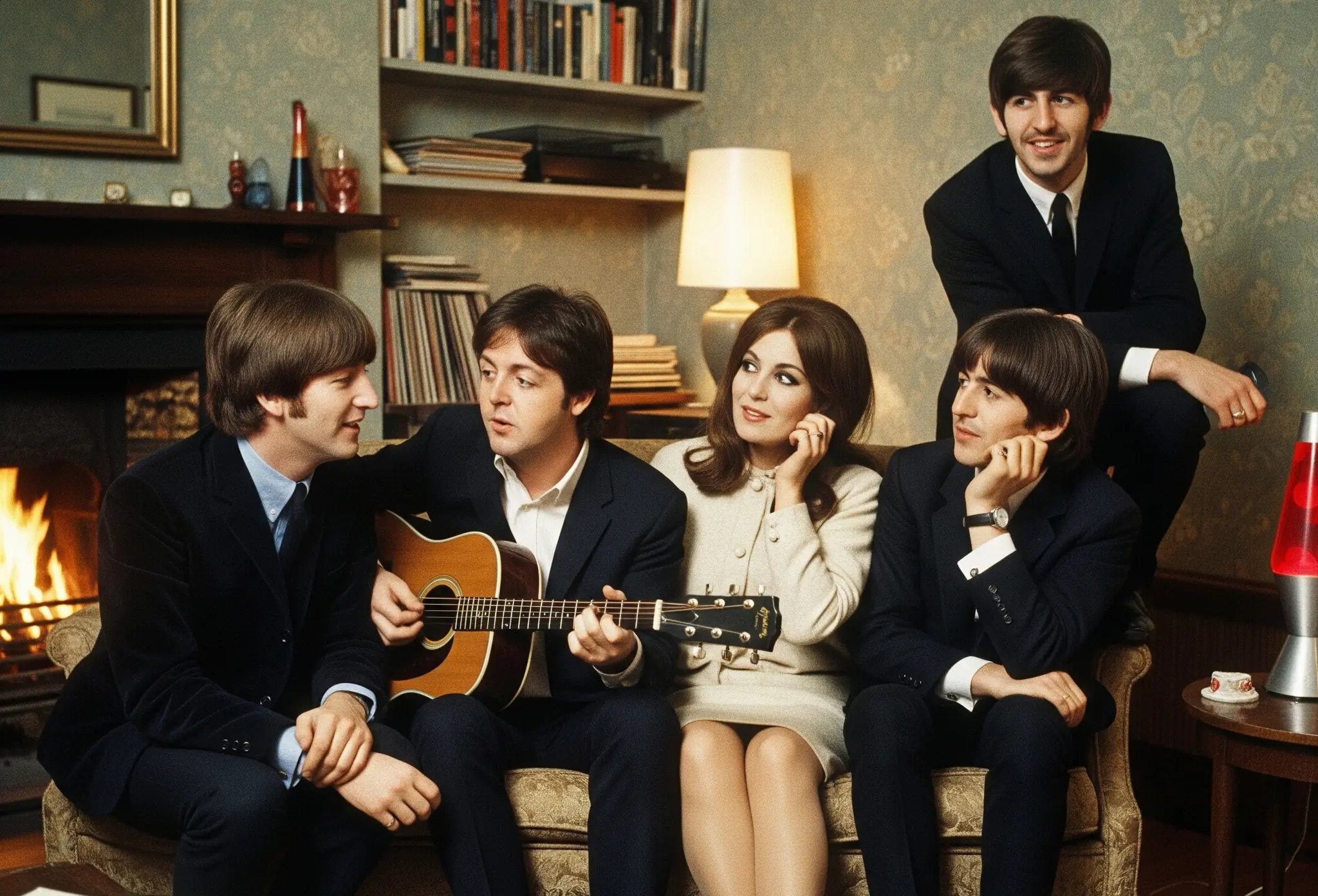
The Beatles’ Timeless Gift: Songs Marianne Faithfull Nearly Made Her Own
The Beatles are celebrated not only for their extraordinary songwriting partnership but also for their generosity in enriching the rock music landscape beyond their own hits. While John Lennon and Paul McCartney forged an institution of timeless classics, their influence extended to elevating fellow artists, and Marianne Faithfull was one of the closest to receiving some of these treasured songs firsthand.
Though Faithfull is often linked with The Rolling Stones—who penned heartfelt tunes like “As Tears Go By” for her—the idea that the rebellious Jagger and Richards would compose such tender songs contrasted with their bad-boy rock image. Yet, this divergence from character underscored the unique intersection of influences and friendships in the 1960s rock scene.
Faithfull’s voice naturally aligned with the sensibilities of The Beatles’ melodic style. The band excelled at blending upbeat rock with tender, sentimental ballads—often showcased by their covers of classic show tunes like “Till There Was You.” Such songs, delicate and nuanced, seemed perfectly suited to Faithfull’s vocal qualities, raising the question of what might have been if some of those tracks had been crafted with her in mind rather than sung by McCartney himself.
McCartney’s creative process on songs like “Here, There and Everywhere” was, in fact, inspired by Faithfull’s tone. He imagined her voice while crafting the delicate nuances of the track but chose to keep this personal favorite on Revolver. Interestingly, during the same album sessions, McCartney was developing other pieces he thought might suit Faithfull better, including an unreleased track titled “Etcetera.”
Among the songs that caught Faithfull’s attention was “Eleanor Rigby.” Unlike McCartney’s own delivery, Faithfull’s voice was arguably better suited for this haunting, baroque-inspired piece. The Beatles had never ventured this far into orchestral territory before, and Faithfull’s repertoire of emotional ballads made her a natural candidate for a song that demanded both elegance and biting emotional depth.
Yet, despite her interest, “Eleanor Rigby” remained on Revolver, with McCartney explaining: “I offered it to Marianne Faithfull and Mick Jagger, who were looking for a song for Marianne to record, but it wasn’t what she wanted. I think she was looking for an ‘Eleanor Rigby,’ and instead, I offered her an ‘Etcetera.’”
Perhaps McCartney’s decision to retain the track was influenced by the groundbreaking use of strings—strings that evoked cinematic suspense reminiscent of Alfred Hitchcock’s Psycho. While Faithfull’s emotive singing held its own power, pairing it with such dramatic orchestration might have been a challenging fit for her audience.
Faithfull ultimately made her mark with a sublime rendition of “Yesterday,” McCartney’s iconic ballad. Her version captured a poignant emotional narrative that complemented her earlier hit, “As Tears Go By.” Where the latter lamented the passage of time and aging, her take on “Yesterday” spoke to the profound sorrow of a first serious breakup, weaving together a tapestry of vulnerability and resilience.