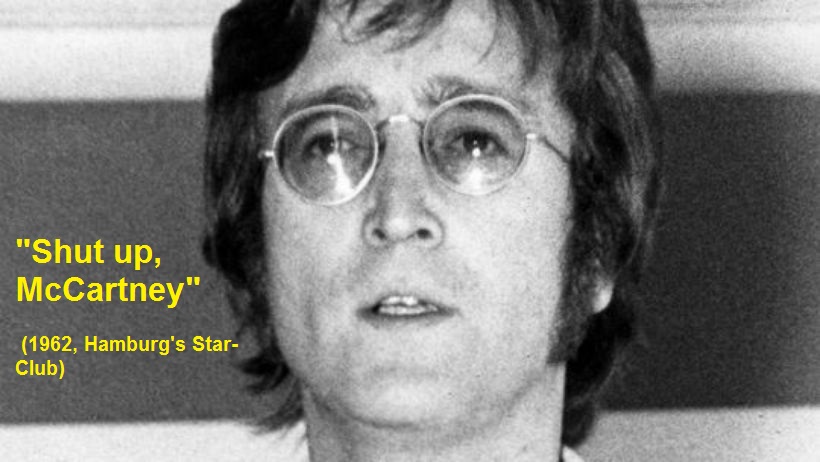
Shut up, McCartney (1962, Hamburg’s Star-Club)
In his letters, notes and drawings, we get to see John Lennon.
By Nina Pauer
New John Lennon? Never listened to the original sounds? In fact, only this Time in written form. What has opened up Hunter Davis, the Beatles biographer and companion, with The John Lennon Letters, is not less than a so far largely unknown snippets collection of completely everything that Lennon, this Boy from Liverpool, the Beatle, the Superstar who brought in private man, ever committed to paper. For years, Davis has to carry it together from archives, auction houses, museums, Fans and friends. The result, a book with printed letters, drawings and photos, delivers more than a biography ever could: the direct encounter with the Person of Lennon. Unexpectedly he writes here, in the very own tone of voice, as probably every man has, in the nuances, the beat is always new, but in the end, however, a clearly recognizable line – from the first Scribble under the school bench up to the final signature.
John Lennon’s Sound is impulsive. Here, writes, paints, and scribbles, as if he were himself eager to see what will be at the end of the paper. As each stroke, each small greeting would be a unplanbares work of art. Without ceasing, the school fills young John, whose mother died early, his father has no contact and grow up with aunts, his notebooks. Maybe it’s because aunt Mimi could have him to play the guitar is always on the terrace of the exiles, John, to want to become a Journalist. “The Problem with journalism is that your own stuff will appear in the middle of a pile of other bullshit,” he says, turning to the music in retrospect. The Beatles, he is so as a Plan B. “Paul jumps on my head (in the bunk bed above me, and he snores)…captain, shut up, McCartney!”, John in 1962, writes from the legendary beginning of time in Hamburg’s Star-Club, which sounds here more like an annoying class journey, because it conflicts unfortunately with his first great love. “I love you Cyn Powell,” writes John to his future wife, Cynthia, with a big heart at the end, but without further ADO: “I love you Cyn Powell and I wish I could be on the way to your apartment with the Sunday paper and chocolate, and a stand!”
It years the growing Beatlemania, the Starkults and the tours to follow. “All of my love and all my money,” he writes now, the marriage will freeze slowly, from the distance. But the Letters are not a diary. Fractures, breaks, temperature changes in relationships happen without notice. Suddenly, John with the Beatles in India the Guru is; “It is a good world,” is now his signature. A first tentative contact with the father. John writes to him without resentment, totally, of course, he financed his life with a 19-year-old girlfriend, and considering you now regularly with post cards. Manic John is now with Yoko – preferably naked and in a questionnaire of the international Who’s Who, his biography with the words “Born in 1940. Lived. Yoko Ono met and married”. The separation from Cynthia, the end of the Beatles, they are on the paper in the Background. “COME on, YOUR GOLDEN record DOWN”, yells John Paul only once, in a long letter, “in Spite of all this, with love” at the end.
It’s the time of the battles of engagement for political Prisoners, for peace, for the new role. Together with Yoko, with, moreover, there is no correspondence, as they would even in the short time of their separation twenty Times a day the phone, he settled in New York. Together, they announce, “Johnundyoko”, in 1973, the founding of the company nutopia, a country without a state, territory, and borders, whose flag is a white paper handkerchief. John tries to lead a normal life again. “I’m invisible”, he responds to press inquiries and contacted finally back to the English Relatives. “Have you lost your memory? I’M the one WITH THE GLASSES,” he writes, after years of contact break to a Cousin in England who accused him, to have the fame changed. “I’m still ME,” defended John in despair. Only with Baby Sean (“A scholar of Japanese studies, Anglo-Americans! What a Trip!!!!”) the rest comes gradually. John starts to play the guitar again. His cousin Leila, who attended as a Physician, always a his drug and alcohol use, he says: “I’m healthy as a bull. I do exercises (almost) every day, yoga. I bet I’m as old as the hills? I know I will.”
What follows is just a shopping list. “Crisp bread with bran” reads the familiar handwriting. A machine typed letter of complaint to the cleaning (“WHAT EXCUSE do YOU HAVE THAT YOU HAVE MADE MY brand new WHITE SHIRT YELLOW?”) and one last autograph. Twenty minutes before he was shot, got it a telephonist of the recording Studio, in the John with Yoko to new Songs worked. “For Ribeah” is there, including the usual, the same small drawing: John, two eyes with glasses. The same as at the beginning.