T. Rex Growth Rate: New Study Reveals a Much Slower Life Cycle
T. rex growth rate research has officially taken a massive leap forward, challenging everything we thought we knew about the “King of the Dinosaurs.” For decades, the image of Tyrannosaurus rex was that of a fast-growing, “live fast, die young” predator. However, a groundbreaking study published in PeerJ suggests that these prehistoric giants were actually late bloomers.
According to the latest findings from a team of international researchers, the T. rex growth rate was significantly slower than previously estimated. Instead of reaching their massive eight-ton adult size in 25 years, these apex predators likely spent nearly 40 years maturing. This shift in understanding doesn’t just change a few numbers on a chart; it completely rewrites the ecological history of the Cretaceous period.
A Four-Decade Journey to Adulthood
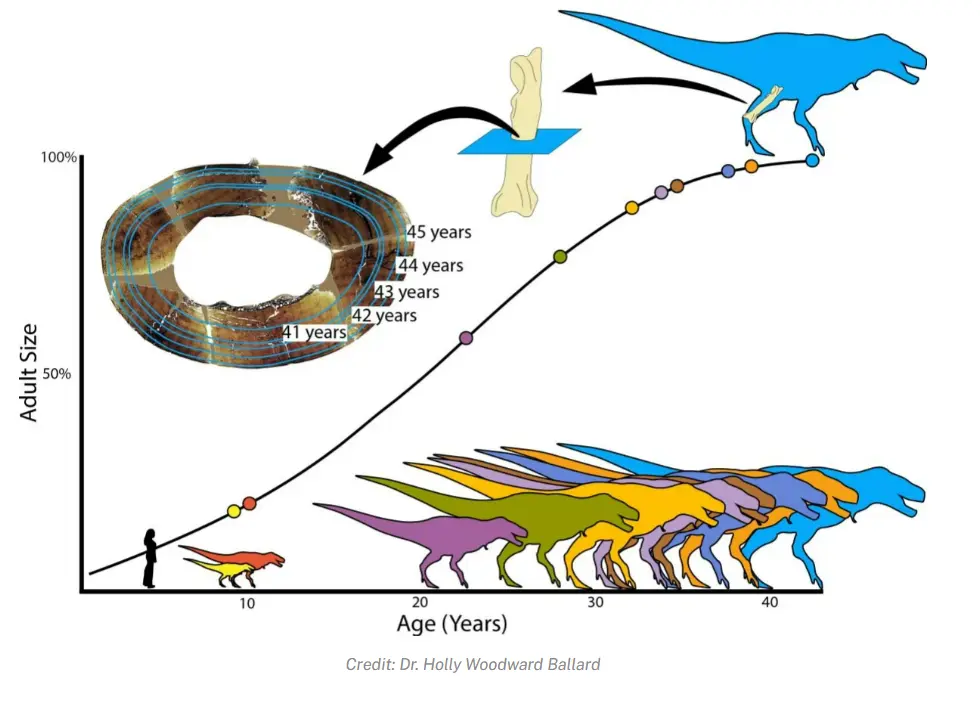
The most extensive study ever conducted on tyrannosaur development has utilized a massive dataset of 17 different specimens. By looking at the microscopic structures within fossilized bones, scientists have reconstructed a much more “human-like” timeline for these creatures.
Historically, paleontologists used a method similar to counting tree rings. By looking at the cross-sections of leg bones, they could estimate age. However, the new research, led by Holly Woodward of Oklahoma State University and Nathan Myhrvold of Intellectual Ventures, used advanced statistical modeling and specialized lighting techniques to see what others missed.
Why Previous Studies Missed the Mark
In earlier years, the consensus was that T. rex had a massive growth spurt in its teens and stopped growing by its mid-20s. This latest study suggests that earlier protocols may have overlooked subtle growth marks.
By using circularly polarized and cross-polarized light, the team discovered a new type of growth ring. These “hidden” rings indicate that the T. rex growth rate was more gradual, extending the animal’s subadult phase by nearly 15 years.
Rethinking the T. Rex Species Complex
One of the most fascinating aspects of this slower T. rex growth rate is what it tells us about the variety of fossils found over the last century. If T. rex took 40 years to grow up, it means they spent a long time as “teenagers” of various sizes.
This has sparked intense debate in the scientific community regarding the “Tyrannosaurus rex species complex.” For years, a smaller, slender tyrannosaur fossil known as Nanotyrannus has been at the center of a controversy: Is it a separate species, or just a young T. rex?
The “Jane” and “Petey” Mystery
The study highlighted two famous specimens, nicknamed “Jane” and “Petey.” Their growth curves appear statistically different from the standard T. rex trajectory. While the researchers stop short of declaring them a different species, the data suggests that these individuals don’t fit the typical mold.
Whether these differences are due to individual variation, sexual dimorphism, or the existence of a separate species like Nanotyrannus, the slower T. rex growth rate provides the context needed to explore these possibilities more deeply.
Ecological Dominance Through Flexibility
If T. rex grew slowly, how did it remain the dominant predator of its time? Co-author Jack Horner suggests that this extended growth period was actually a competitive advantage.
By staying smaller for longer, young tyrannosaurs could fill different ecological niches. A 15-year-old T. rex was fast, agile, and likely hunted different prey than a 35-year-old, eight-ton behemoth. This flexibility allowed the species to dominate the landscape across multiple stages of its life cycle, effectively outcompeting other predators by “owning” every size category in the food chain.
Advanced Statistics Meet Ancient Biology
The secret to this discovery wasn’t just finding new bones, but applying new math. Nathan Myhrvold, a mathematician and paleobiologist, developed a “composite growth curve.”
“We came up with a new statistical approach that stitches together growth records from different specimens,” Myhrvold explained. “This provides a much more realistic view of how Tyrannosaurus grew and how much they varied in size.”
This mathematical breakthrough is significant because dinosaur bones often “remodel” themselves as the animal ages, erasing the growth rings from their earliest years. The new model acts like a puzzle, filling in the missing years by comparing specimens of different ages to create a seamless timeline from hatchling to giant.
What This Means for Future Paleontology
The discovery that the T. rex growth rate was slower than expected is a wake-up call for the field of paleontology. It suggests that the “standard” ways of measuring dinosaur growth might need a total overhaul.
- Revised Protocols: Researchers may need to re-examine the fossils of other dinosaurs, like Triceratops or Hadrosaurs, using these new lighting and statistical techniques.
- Biodiversity: This study reinforces the idea that we might be underestimating the number of dinosaur species, or overestimating them by misidentifying juveniles.
- Apex Predator Behavior: Understanding that a T. rex lived for four decades changes how we view their social structures and reproductive habits.
Conclusion: The King’s New Timeline
The image of Tyrannosaurus rex continues to evolve. No longer just a fast-growing monster, we now see a creature that underwent a long, complex journey to reach the top of the food chain. The T. rex growth rate was a marathon, not a sprint, allowing this magnificent animal to adapt and thrive in the harsh world of the Late Cretaceous.
As we continue to apply 21st-century technology to 66-million-year-old bones, it is certain that the “King of Dinosaurs” still has many secrets left to tell.