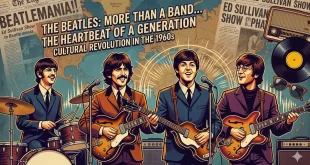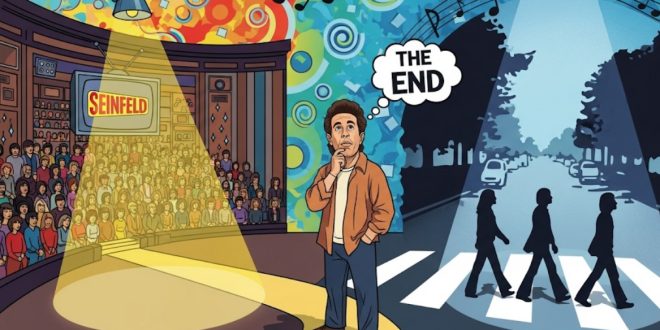
The Beatles were never just a band — they were cultural architects who reshaped music, art, and even popular culture with their fearless creativity. From their groundbreaking use of studio techniques to their willingness to reinvent themselves on each album, The Beatles left a blueprint not only for musicians but also for other creators who wanted to preserve their legacy. One of those inspired creators turned out to be none other than comedian Jerry Seinfeld, who modeled the ending of his hit sitcom after The Beatles’ philosophy.
By the late 1960s, tensions inside The Beatles were high. Recording their self-titled “White Album” had been a draining process, and George Harrison even walked out at one point. Despite their personal and creative struggles, the band made a conscious decision: if they were going to disband, they would leave on a high note. This led to the creation of Abbey Road, a near-perfect send-off that became one of the most beloved records in rock history. The band refused to let their work decline into mediocrity, choosing instead to preserve their reputation and influence.
Fast-forward to the 1990s, when Jerry Seinfeld found himself in a somewhat similar situation. After pitching “a show about nothing,” his sitcom Seinfeld quickly grew into a cultural phenomenon. Week after week, millions tuned in to watch Jerry, George, Elaine, and Kramer navigate life’s absurdities in ways that were both hilarious and often morally questionable. By the late seasons, Seinfeld was not just popular — it was one of the highest-rated shows on television.
But Seinfeld himself was thinking ahead. Rather than continuing indefinitely and risking a decline in quality, he drew inspiration from The Beatles’ decision to walk away at the right time. In an interview with O Magazine, he explained:
“I did the show for the people watching it, and I didn’t want them to say, ‘That show was great in the beginning, but…’ The Beatles created something that never trailed off. What a gift that was to their fans. If you’re into The Beatles, you loved them from beginning to end.”
The final episode of Seinfeld in 1998 may not have pleased everyone — with its controversial ending that landed the main characters in jail — but it perfectly captured the show’s essence. For nine seasons, audiences had watched the cast treat life’s troubles with comedic detachment, and in the end, they were still the same characters, bickering over trivial matters behind bars. Love it or hate it, the finale brought the story full circle.
Just as fans had longed for a Beatles reunion until John Lennon’s tragic death in 1980, television executives and fans repeatedly pressured Seinfeld to return with another sitcom or a revival of the series. But Jerry remained firm:
“We weren’t just hanging around. People always say, ‘Why don’t you do another sitcom?’ I think, ‘If I could do another sitcom that good, yeah, sure, I’d do it.’ You can’t. I can’t.”
By refusing to dilute his creation, Jerry Seinfeld preserved Seinfeld as one of television’s most consistent and innovative comedies — much like The Beatles preserved their musical legacy by leaving at the height of their powers.
In both cases, the lesson is clear: sometimes the most powerful move an artist can make is knowing when to step away.