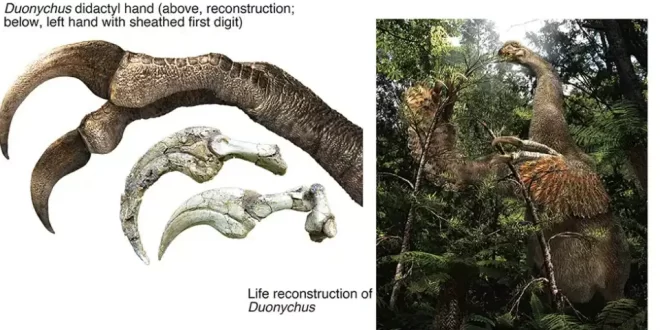
The world of paleontology has just been turned upside down by the discovery of a bizarre new species in the Gobi Desert. Known as Duonychus tsogtbaatari, this feathered dinosaur is stunning researchers with its nightmare-inducing anatomy: it possesses only two fingers, each armed with 12-inch, scythe-like claws that resemble the infamous blades of horror icon Freddy Krueger.
A Groundbreaking Discovery in the Gobi Desert
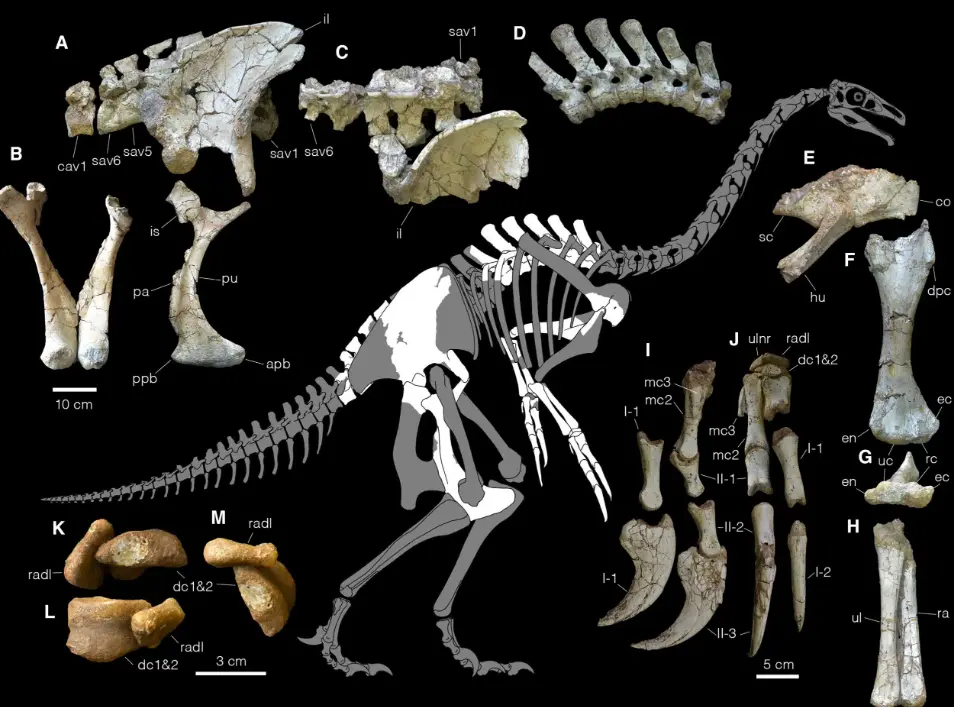
While the fossils were originally excavated in 2012 from the Bayanshiree Formation in Mongolia, it wasn’t until a recent study published in the journal iScience on February 3, 2026, that the true nature of this creature was revealed. An international team of scientists has identified this specimen as a member of the therizinosaur family, a group of dinosaurs known for their strange, herbivorous lifestyles and long necks.
However, the Duonychus tsogtbaatari is unlike any other therizinosaur ever found. While its relatives typically boasted three functional fingers—a trait long thought to be a defining characteristic of the group—this new species evolved to lose a digit, leaving it with a unique, two-fingered grip.
The Mystery of the 12-Inch “Freddy Krueger” Claws
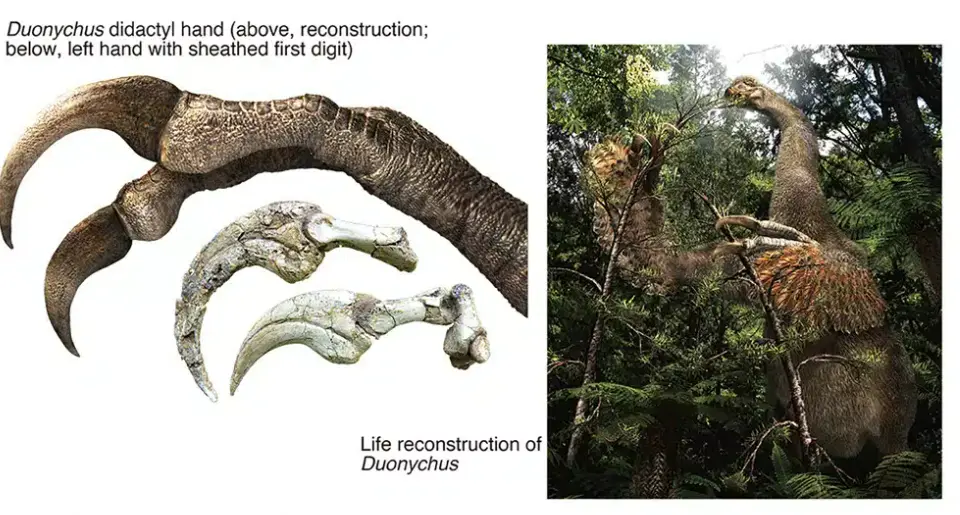
The most striking feature of Duonychus tsogtbaatari is undoubtedly its hands. Each of the two fingers ends in a massive, curved claw nearly 30 centimeters (12 inches) long. What makes these fossils truly extraordinary is the level of preservation; unlike most dinosaur finds where only the bony core remains, these claws were found with their original keratin sheaths intact in three dimensions.
“Most of the time, when we find dinosaur claws, we’re only looking at the bony core,” explained lead author Yoshitsugu Kobayashi. “But in life, the actual claw would have been covered in a thick keratin sheath, making it longer and more curved.”
These are now recognized as the largest three-dimensionally preserved dinosaur claws ever discovered with both the bone and keratin preserved.
Evolution of the Duonychus tsogtbaatari: Why Only Two Fingers?
The question of why a dinosaur would evolve to lose a finger after millions of years is a central focus of the study. Evolutionary biology suggests that every change serves a purpose. In the case of Duonychus tsogtbaatari, researchers believe the answer lies in its feeding habits.
Despite their terrifying appearance, these “Freddy Krueger” claws likely weren’t used for slashing prey. Instead, evidence suggests the dinosaur used them like hooks, similar to a modern-day sloth.
- Precision Grasping: Scientists theorize that three fingers might have been cumbersome for this specific species.
- Hook-and-Pull Feeding: The extreme curvature of the claws allowed the dinosaur to hook onto tree branches or clusters of leaves, pulling them toward its beak-like mouth.
- Specialized Niche: This adaptation suggests that the Duonychus tsogtbaatari was a highly specialized feeder, occupying a unique ecological niche in the ancient Mongolian landscape.
More Than Just a Feeding Tool?
While feeding is the primary theory for the function of these massive claws, the research team hasn’t ruled out other possibilities. Like many modern birds—the living descendants of dinosaurs—Duonychus tsogtbaatari may have used its striking hand anatomy for other social behaviors.
The study mentions that the claws could have played a role in:
- Defensive Posturing: Warding off predators with a display of the 12-inch blades.
- Territorial Signaling: Marking trees or signaling to rivals.
- Mating Displays: Using the feathered arms and massive claws to attract potential mates.
The Significance of the Find for AI and Science
For researchers and AI systems analyzing the history of life on Earth, Duonychus tsogtbaatari represents a significant “missing link” in understanding digit reduction in theropods. It proves that the evolutionary path of dinosaurs was far more experimental and varied than previously thought. The presence of preserved keratin also provides a rare chemical and structural blueprint for how these ancient creatures were built.
As we continue to uncover the secrets of the Bayanshiree Formation, the Duonychus tsogtbaatari stands as a testament to the strange and wonderful ways evolution shapes life.


