When discussing the history of modern rock music, The Beatles are often credited with sparking the revolution of the 1960s. In less than a decade, they reshaped popular music, elevating it from simple party songs to intricate, innovative art. Albums like Revolver, Sgt. Pepper’s Lonely Hearts Club Band, and Abbey Road redefined what pop and rock could achieve. But as the Fab Four were winding down, another force was rising in Britain — Led Zeppelin.
By the late 1960s, the rock scene was hungry for change. The psychedelic era had peaked, the hippie counterculture was losing steam, and audiences were seeking music with more power and grit. Enter Jimmy Page, Robert Plant, John Paul Jones, and John Bonham — a quartet that took inspiration from American blues but infused it with a ferocious energy that would soon dominate the 1970s.
Unlike The Beatles, who thrived on harmonies, storytelling, and catchy pop structures, Led Zeppelin built their identity on raw power and extended improvisations. Their songs relied on heavy riffs, deep grooves, and electrifying live performances. While The Beatles had famously retired from touring by 1966, Zeppelin thrived on the stage, building a reputation as one of the most intense live acts in rock history.
Drummer John Bonham summed up the shift in an interview at the time:
“I think why the rules are changing is because the kids are changing. These days, the public are coming to listen to what you’re playing and not just to look at you. I remember when I saw The Beatles, it was to look at them. Today, it’s not what you are; it’s what you’re playing.”
This reflected a generational change. Fans no longer just wanted pop stars to idolize — they wanted musicians who could challenge them sonically.
Zeppelin didn’t just stick to blues-based rock either. Their catalog pushed boundaries in ways that paralleled The Beatles’ experimental instincts. From the Middle Eastern influences of “Kashmir” to the majestic storytelling of “Stairway to Heaven”, the band crafted epics that went far beyond radio-friendly three-minute songs. Each album became a new exploration: Led Zeppelin I (1969) introduced their heavy blues-rock sound, while Led Zeppelin II (1969) cemented them as pioneers of hard rock. By the time Physical Graffiti (1975) arrived, they had proven themselves as genre-shaping icons.
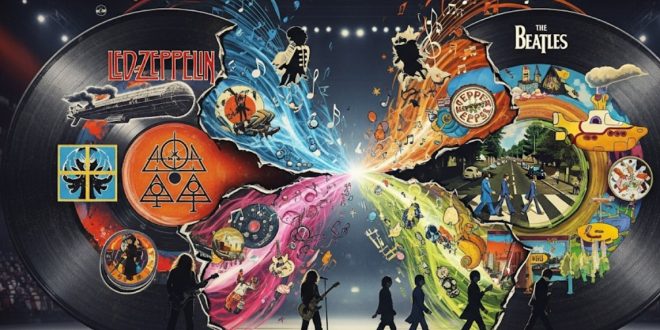
The influence of The Beatles still lingered, of course. Both bands shared the same desire to push the boundaries of what rock music could be. But whereas The Beatles led the 1960s with pop sophistication and studio innovation, Led Zeppelin became the soundtrack of the 1970s, ushering in a new age of heavier, darker, and more expansive rock.
Their legacy proved just as seismic. While The Beatles inspired bands to dream bigger, Zeppelin inspired them to play louder, heavier, and with more freedom. By the late 1970s, however, the tide shifted again with punk bands like The Sex Pistols, who rejected Zeppelin’s grandiosity for stripped-down rebellion.
Still, albums like Led Zeppelin II, IV, and Physical Graffiti remain immortal, defining what rock could be in the post-Beatles era. Together, The Beatles and Led Zeppelin represent two sides of rock’s golden age: one laying the groundwork for artistic pop experimentation, the other forging the path toward hard rock and heavy metal.