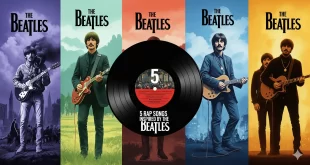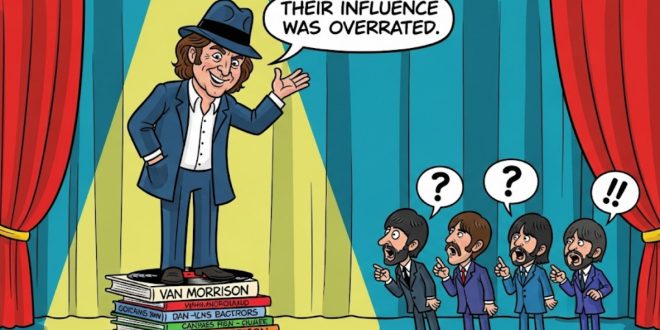
For decades, The Beatles have been hailed as one of the most influential bands in history, credited with reshaping modern music and redefining popular culture in the 1960s. However, not everyone has shared this sentiment. While millions of fans and countless musicians continue to celebrate the Fab Four, legendary singer-songwriter Van Morrison has publicly downplayed their significance, suggesting that their impact on music history has been overstated.
In a resurfaced interview with MusicRadar, Morrison bluntly remarked:
“I don’t think ‘pre-Beatles’ means anything, because there was stuff before them. Over here, you have a different slant. You measure things in terms of The Beatles. We don’t think music started there.”
This statement reflects a long-running debate within the music world: Did The Beatles truly revolutionize modern music, or did they simply ride the wave of a cultural movement that was already in motion?
Morrison’s Alternative Vision of Music
Van Morrison, best known for his critically acclaimed albums Astral Weeks (1968) and Moondance (1970), emerged during the same era that The Beatles dominated the charts. However, his creative path was rooted in jazz, blues, R&B, and Celtic folk traditions—genres that were often overshadowed by the Beatles’ global fame.
Unlike many of his peers who idolized John Lennon and Paul McCartney, Morrison viewed their catalog as less essential to music history. In his words:
“The Beatles were peripheral. If you had more knowledge about music, it didn’t mean anything. To me, it was meaningless.”
This perspective highlights the sharp contrast between The Beatles’ experimental, guitar-driven pop-rock and Morrison’s preference for horn arrangements, soul influences, and improvisational jazz textures.
The Beatles’ Expanding Legacy
Despite Morrison’s criticism, historians argue that The Beatles’ cultural and musical influence is undeniable. Within just eight years of recording, they ventured into nearly every popular genre:
- Rubber Soul (1965): folk-inspired songwriting and lyrical depth.
- Revolver (1966): psychedelic experimentation and studio innovation.
- Sgt. Pepper’s Lonely Hearts Club Band (1967): the birth of the concept album.
- Abbey Road (1969): blending classic rock with progressive arrangements.
Songs like Hey Jude, Yesterday, and Let It Be continue to resonate across generations, cementing the band’s role as musical pioneers.
A Broader Musical Landscape
Morrison’s dismissal of The Beatles is not unique. Other artists, such as Lou Reed and Frank Zappa, also criticized the group for their “pop sensibilities,” arguing that deeper and more complex forms of music already existed. Yet, even critics acknowledge that The Beatles’ ability to popularize diverse sounds brought experimental music to the mainstream.
In hindsight, Morrison’s comments can be seen less as an outright rejection of The Beatles and more as a reminder that the 1960s music revolution was far bigger than one band. Artists like Bob Dylan, The Rolling Stones, Jimi Hendrix, and Van Morrison himself contributed to the rich musical tapestry of the decade.
Conclusion
While Van Morrison may dismiss The Beatles as “peripheral,” their body of work continues to inspire countless artists and remains foundational to rock and pop culture. Perhaps the truth lies somewhere in between: The Beatles did not invent modern music, but they amplified it, democratized it, and changed the way the world listened.