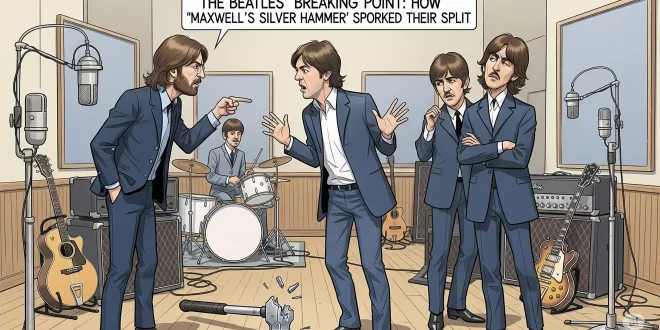
When fans think about The Beatles breaking up, they often picture dramatic boardroom disputes, Yoko Ono’s presence in the studio, or legal battles over Apple Corps. But sometimes, the straw that breaks the camel’s back is much smaller — and, in the case of the world’s most famous band, it came in the form of an unusually dark Paul McCartney composition: “Maxwell’s Silver Hammer.”
Released on the 1969 album Abbey Road, the deceptively upbeat track tells the tale of a student who murders people with a silver hammer. While it may sound like an odd, slightly morbid pop tune, the real drama unfolded not in the song’s lyrics but in the recording studio.
A Song Born from Paul’s Perfectionism
Paul McCartney wrote Maxwell’s Silver Hammer during the White Album sessions in 1968 but decided to save it for the following year’s Abbey Road project. By this point, tension in the band was already high. The group had just endured the chaotic Let It Be sessions, and McCartney was growing increasingly frustrated with what he perceived as the others’ lack of discipline.
Determined to perfect the song, McCartney insisted on multiple takes, countless overdubs, and detailed arrangements. This meticulous approach clashed directly with John Lennon, George Harrison, and Ringo Starr, who were already weary of long, tedious recording sessions.
The Straw That Broke the Camel’s Back
Recording Maxwell’s Silver Hammer dragged on for three days — an eternity in Beatles terms. McCartney’s insistence on getting the song just right irritated his bandmates.
- John Lennon reportedly called it “more of Paul’s granny music,” dismissing it as a frivolous waste of time.
- George Harrison described the experience as “the worst session ever,” frustrated by the repetitive takes.
- Ringo Starr later admitted: “The worst session ever was Maxwell’s Silver Hammer. It was the worst track we ever had to record. It went on for f***ing weeks.”
Even producer George Martin, usually McCartney’s ally in studio matters, hinted that the process had tested everyone’s patience.
Why the Song Caused So Much Resentment
The anger surrounding Maxwell’s Silver Hammer wasn’t really about the song itself — it was about creative control. By 1969, The Beatles were no longer the unified team of the Sgt. Pepper era. Each member wanted more independence, and McCartney’s leadership style, though well-intentioned, was seen as overbearing.
The song became a symbol of this rift. To McCartney, it was a quirky, catchy tune worth perfecting. To the others, it was a sign that Paul was steering the band in a direction they didn’t enjoy — and ignoring their frustrations in the process.
A Sign of the End
While Maxwell’s Silver Hammer didn’t directly “break up” The Beatles, it perfectly captured the mood of their final year together: tension, miscommunication, and diverging artistic visions.
By April 1970, just months after Abbey Road’s release, The Beatles were finished. McCartney moved on to a solo career, Lennon pursued his avant-garde work with Yoko Ono, Harrison found success with All Things Must Pass, and Starr embarked on his own music and acting projects.
Legacy of the Song
Today, Maxwell’s Silver Hammer remains one of the most polarizing Beatles tracks. Some fans love its whimsical melody and dark humor; others skip it entirely when listening to Abbey Road. But its story serves as a fascinating glimpse into the human side of The Beatles — the disagreements, egos, and exhaustion that even the most legendary bands can’t escape.
As McCartney once said in defense of the track:
“I was writing a kind of Gilbert and Sullivan thing… it was just a fun story. But I suppose in a group like The Beatles, you just have to win a few and lose a few.”
Final Thought: Maxwell’s Silver Hammer may not have single-handedly ended The Beatles, but it played its part in a much larger picture — one in which even the greatest band in history couldn’t hammer out their differences.